Thursday, July 26, 2007

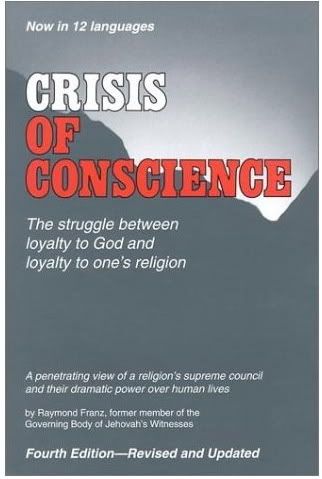
Book Review: "Crisis of Conscience" by Raymond Franz

Photo Sharing and Video Hosting at Photobucket


If you want a book that emphatically proves that the Watchtower is an unreliable organization, then this is your book. I can't imagine how any Jehovah's Witness can read this book and yet remain a member.

The author, Raymond Franz, was a Jehovah's Witness for most of his life as well as a governing body member. This is his story. He tells of how he became involved in full time service to the organization all the way up to his being disfellowshipped.

About half of the book is devoted to Franz's personal testimony and what he experienced as not only a full time staff member, but as a governing body member too. These are insights that very few men have chosen to reveal. This includes everything from the Society's scandelous cover-ups to the inner workings of the governing body.

What I found most valuable was Franz's allegations towards the Watchtower as a false prophet. Hundreds of pages were used to deal with the false prophecies of 1914 and 1975, as well as a few others.

Although the book is quite lengthy (over 400 pages), it is not a boring read. If you are interested in Jehovah's Witnesses, then you'll enjoy this book. Raymond Franz is a passionate writer and does everything he can to be fair. Very little is dealt with in regards to theology. In fact, Raymond Franz probably held and continues to hold to the core doctrines of the Watchtower. The entire thrust of the book is to stress the book's subtitle: "The struggle between loyalty to God and loyalty to one's religion." With this, i'll agree that Raymond Franz most certainly accomplished his purpose in writing this book.

Tuesday, July 17, 2007

Freedom FROM religion? Or freedom OF religion


When I first saw this clip, I was sick to my stomach. Many emotions went through my mind; one of these emotions being, "I shouldn't be feeling this way." I only say this because something inside me wanted to have the "go get em', take one for the team!" type attitude. But I couldn't.

I couldn't get past the fact that we live in a country where we all have the freedom to pray to and worship whoever we please. Rather than disagree with AK47's, we can disagree by using education and good argumentation. But is there a difference in freedom FROM religion and freedom OF religion? Let's look at the latter.

If we have freedom OF religion, and we choose to abide by this, then in no way should we stop such a man making such a prayer in the Senate. Now, you may disagree with his religion completely. I do, anyways. But just because I disagree with it doesn't mean that he has rights too.

But what about freedom FROM religion? If we declare that hindu's don't have the right to pray at a Senate meeting such as this, then what rights do Christians have? Are we going to be consistent in upholding the law of the land or not? At any rate, I found the behavior of those who interrupted the prayer to be repulsive and disrespectful. I couldn't imagine a more rude way at getting your message across.

Since i'm not much of a politician, these are still issues i'm thinking through. I'd appreciate all your thoughts on the matter.

*By the way, all the quotes mentioned in my last blog were from the Watchtower Bible and Tract Society; also known as Jehovah's Witnesses.

Sunday, July 15, 2007

What is a false prophet?

Deuteronomy 18:20-22 says,

"But the prophet who speaks a word presumptuously in My name which I have not commanded him to speak, or which he speaks in the name of other gods, that prophet shall die. You may say in your heart, 'How will we know the word which the LORD has not spoken?' When a prophet speaks in the name of the LORD, if the thing does not come about or come true, that is the thing which the LORD has not spoken. The prophet has spoken it presumptuously; you shall not be afraid of him."

Is it not true that, from this passage, if someone predicts a specific event for a particular year and that it does not come to pass, then is that person a false prophet?

In light of this, read the following quotes and tell me if you think that the one speaking them is a false prophet:

"Our Lord, the appointed King, is now present, since October 1874, A.D., according to the testimony of the prophets."

"Surely there is not the slightest room for doubt in the mind of a truly consecrated child of God that the Lord Jesus is present and has been since 1874."

"The battle of the great day of God Almighty (Rev. 16:14), which will end in A.D. 1914 with the complete overthrow of earth's present rulership, is already commenced."

"The date of the close of that 'battle' is definitely marked in Scripture as October 1914. It is already in progress, its beginning dating from October 1874."

"We see no reason for changing the figures; nor could we change them if we would. They are, we believe, God's dates, not ours. But bear in mind that the end of 1914 is not the date for the 'beginning', but for the 'end' of the time of trouble. We see no reason for changing from our opinion expressed in the View presented in the...in Jan. 15, 1892. We advise that it be read again."


At this point I don't want to mention who these quotes are from. I just want the reader to think and decide if the one speaking them would be considered a false prophet or not in light of Deut. 18:20-22? Your thoughts?

Thursday, July 12, 2007

My experience at the 2007 District Convention of the Jehovah's Witnesses pt. 2

After the talk, me and Daniel went out for lunch. Yes, I was told that I should bring my lunch. Why I didn't I have no idea. It wasn't a big deal, but we could have very easily lost our seat. At any rate, we went out, brought back our lunch, and sat down next to the building. Since we stuck out like a sore thumb at this convention, we were hoping that some people would come and talk to us. No one did. I'm not saying this because i'm accusing the JW's of being rude. I"m only saying this because we wanted an opportunity to share our beliefs with them.
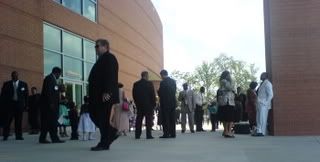


Photo Sharing and Video Hosting at Photobucket


As we finished up our lunch we went inside to find our seats. As we approached the aisle, a family that we had been briefly introduced to earlier began talking to us. They asked us what we thought of the program thus far. I replied with "interesting" and "educational." I didn't want to say "Yeah, it was great!" That would be completely untrue. We talked very briefly about some aspects of JW beliefs, but didn't get very far before they started asking us about our personal lives. This led to a good conversation about my and Daniel's music careers. The mom told us all about how her father was a huge music producer and all this stuff. They seemed really interested in our lives. This was really refreshing because I was feeling a bit awkward at the conference. Anyways, we exchanged contact information and went back to our seats.
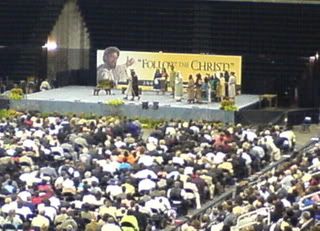
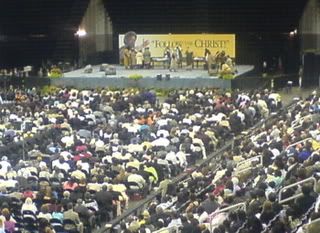

Photo Sharing and Video Hosting at Photobucket


Photo Sharing and Video Hosting at Photobucket


The next event that took place was the drama. This is the part of the entire convention that all the Jehovah's Witnesses seem to look forward to the most. So let's just say I was expecting something spectacular. The entire play was pre-recorded. The only thing that was "live" was the motions. I'm sure there were reasons for this, but I wasn't exactly impressed. Hopefully I didn't just offend any JW's. The drama just didn't do it for me.

The next talk was, quite honestly, one of the worse talks i've ever heard. It was titled "Why All Suffering is Soon to End." It was based on the May 15, 2007 Watchtower, pg. 21-25. And what was this talk about? Predestination. Let me just sum up for you how I feel about JW's talking about predestination. First off, they couldn't be more against it. Secondly, they have no idea what they are talking about. I've said it before and i'll say it again; don't criticize something that you know nothing about. Would it be fair for me to criticize JW beliefs if i've never read any of their publications? Of course not; at least not publicly in front of 9,000 people!

Anyways, the presentation was so rampant with errors and strawmen that I hardly know where to begin. The gist of the talk was that the suffering we see in the world is not God's fault and will soon end. Of course, all Calvinists will agree with this. But read how the Watchtower portrays the "predestination" perspective:

"Third, we may need to help the person to see that God is not responsible for the wickedness so prevalent in the world. Many people are taught that God is ruling this world that we live in, that God long ago determined everything that happens to us, and that he has mysterious, inscrutable reasons for inflicting misery on mankind. These teachings are false. They dishonor God and make him out to be responsible for the wickedness and suffering in the world. So we may have to use God's Word to set such matters straight. (2 Timothy 3:16) Jehovah is not the ruler of this corrupt system of things; Satan the Devil is. (1 John 5:19) Jehovah does not predestine his intelligent creatures; he gives each one freedom and opportunities to choose between good and bad, right and wrong. (Deuteronomy 30:19) And Jehovah is never the source of wickedness; he hates wickedness and cares for those who suffer unjustly. -Job 34:10; Proverbs 6:16-19; 1 Peter 5:7" (pg. 22)

So there you go! Apparently the Watchtower is not trying to convince anyone who is actually informed on the subject. If you are a Jehovah's Witness, do you actually think that the WT has actually read and studied reformed theology? In fact, if I were a betting man, I would be willing to bet that the WT has not studied any writings of the reformers. Why do I say this? Because the position they are arguing against doesn't belong to reformed thinkers! Sure, there are people on the streets who might believe these things. But why not argue against the best that the other side has to offer?

If the WT knew anything about reformed theology, they would understand that Calvinists teach something called "primary" and "secondary" causes. In other words, we teach divine sovereignty and human responsibility. Is this acknowledged? Of course not. Its the typical arminian strawman argument that goes, "those Calvinists just blame God for everything!" I'm not sure if the WT is even aware of these verses, but they should definitely check out Genesis 50:20, Isaiah 10:12, and Acts 4:27-28. It will definitely shed some light on the subject and conclusively prove that God is sovereign, predestines all things, and still holds man responsible.

But the most disturbing aspect of the quote above is in regards to the admission that "Jehovah is not the ruler of this corrupt system of things." What? Is the WT saying that there are things in this world that are beyond his control? Thats right. According the the WT, Jehovah is not all powerful; at least not right now anyways. On the contrary, JW's believe that Satan is in control of this world. And their proof? 1 John 5:19, "We know that we are of God, and that the whole world lies in the power of the evil one."

Not very convincing. Just like Arminians, JW's refuse to deal with the semantical range of the word "World." Its as if "world" always means "everything, including all men, women, and children along with everything that exists under the sun." Is this the case? Hardly. Get out your trusty Strong's concordance and see for yourself. Look up the word "World" and check out every instance where its use. You'll be suprised with what you'll find. For example, you'll read in John 17:9, "I ask on their behalf; I do not ask on behalf of the world, but of those whom you have given me." In other words, the "world" that Jesus speaks of is a separate group of people than "those you have given Me." Thats right. "World" in John 17:19 doesn't mean "the entire planet."

So what does 1 John 5:19 mean? Notice the contrast between "we are of God" and "the world." It is a separate group of people. It is speaking of unbelievers. Yes, unbelievers are in control of Satan. 2 Timothy 2:26 confirms this. But keep in mind that all those who are in control of the Devil are there because they want to be. The reformed position in no way teaches that unbelievers are robots and Satan is controlling them with a remote. No. The unregenerate willingly submit themselves to their master, Satan. Does this mean that Jehovah isn't in control? Of course not! In fact, Jehovah is so in control of the "world" that he is active in supressing their unbelief! Want proof? Check out John 12:39,

For this reason they could not believe, for Isaiah said again, "He has blinded their eyes and He hardened their heart, so that they would not see with their eyes and perceive with their heart, and be converted and I heal them."

Wow. That is powerful! Jehovah hardens their hearts so that they wouldn't be converted! Could statements like this really be true if Jehovah weren't in control? I'll let you be the judge of that. But what really got me was that the speaker constantly said that "Predestination is of the Devil." For a while I felt like I was listening to a sermon from an Arminian Southern Baptist!

At this point, some might be thinking that i'm being too harsh. And maybe I am. But keep in mind that the Watchtower makes claims for itself that demand such a treatment. Think about the following quotes in light of how I responded above:

"Q. Didn't you state that on October 15, 1931, the Watch Tower discontinued the naming of an editorial committee and then Jehovah God became the editor? A. I didn't say Jehovah God became the editor. It was appreciated that Jehovah God really is the One who is editing the paper, and therefore the naming of an editorial committee was out of place. Q. At any rate, Jehovah God is now the editor of the paper, is that right? A. He is today the editor of the paper." (Olin Moyle v. The Watchtower, 1943, sections 2596-2597)

"But you don't make any such statement, that you are subject to correction, in your Watchtower papers, do you? A. Not that I recall. Q. In fact, it is set forth directly as God's Word, isn't it? A. Yes, as His word. Q. Without any qualification whatsoever? A. That is right." (Olin Moyle v. The Watchtower, 1943, section 4421)

*if photocopies of these documents are requested, i'd be more than happy to provide them.

Because the Watchtower makes such claims (there are ones more amazing than this, believe it or not), I have no choice but to hold them to the highest possible standard. Although I am going to continue in my research, the Jehovah's Witnesses have not thus far made a good impression as an organization with full academic and scholarly integrity.

To conclude, the District convention was a great experience. It allowed me to see first hand how the organization operates. Many have read about the organization, but few have given consideration to attending their services and meetings. And when you do, you'll truly see for yourself what kind of organization these millions of people are a part of.
Tuesday, July 10, 2007

My experience at the 2007 District Convention of the Jehovah's Witnesses pt. 1

Photo Sharing and Video Hosting at Photobucket


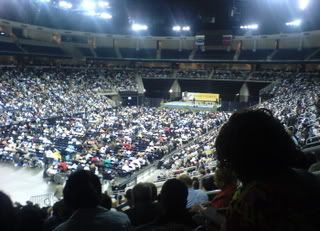
The past sunday July 1, 2007 me and my friend Daniel attended the 2007 District Convention of Jehovah's Witnesses. I must say that it was both interesting and educational. Let me start with the interesting.

On our way to the venue, we were followed by a really sweet car. It was a Lotus. I thought they stopped making those? Apparentely not. As we pulled into the packed parking lot, guess who parked beside us? You guessed it; a freakin sweet, brand new, Lotus. And no, I didn't get a picture :-(


Photo Sharing and Video Hosting at Photobucket


As we were walking in we realized that we were late because it seemed that everyone had pretty much found their seat. Luckily, one of the ushers, Tom, found a pretty descent seat for us. Ok, so maybe it wasn't so descent.


Photo Sharing and Video Hosting at Photobucket


As we found our seat, a short talk was delivered titled, "Examining the Scriptures Daily Builds Endurance." Most of the talks were ones that most Christians wouldn't have a problem with. There were slants here and there, but for the most part it was fairly agreeable. I'm not going to lie though; the talks were not that exciting. They were very dry and dispassionate. In fact, I would be willing to bet that each of the talks, with the exception of the last, was prewritten by the Watchtower. I'm sure each speaker (there were many) added his own expressions and wording occassionaly; but for some reason I doubt that each speaker wrote each message on his own. Either way it doesn't really matter; its the content that is important.

The Hymns were especially awkward. As everyone stood up to sing to a prerecorded orchestra track, me and Daniel decided to stand up to out of respect. But the last thing we were going to do was sing. Unfortunately, the guy next to me decided to give me a hymn to sing. I smiled and accepted it. At this point I regret it, but I didn't have the guts to say no. But it was quite educational, as we got to read what they were actually singing. One of the hymns (207) were of particular interest because it spoke of not having two masters and two Gods but rather to have only one master and one God, Jehovah. Immediately, I was reminded of Jude 4;

"For certain persons have crept in unnoticed, those who were long beforehand marked out for this condemnation, ungodly persons who turn the grace of our God into licentiousness and deny our only Master and Lord, Jesus Christ.."

If Jesus is your only Lord and Master (which Trinitarians have no problem with), then how can you sing hymns that say you don't serve two Gods or two Masters if you, as a Jehovah's Witness, clearly do? I wondered if anyone else realized the implications of this hymn? Probably not.

After a long series of talks, we finally got to a talk that seemed to carry some interesting points. It was titled, "Who are the realy followers of Christ?" Me and Daniel looked at each other and nodded as we were hoping for something interesting. It turned out to be what I expected; the typical "we are unique and different from everyone else" talk that we often hear of JW's. And they are right! They most certainly are unique.

I wish I had taken notes, but there were only a few points that really aroused my interest; those being the Divine Name and the door-to-door ministry. I think this talk was meant to be not only an encouragement to JW's, but an "evangelical" message to show non-JW's what the JW's are all about.

The Divine name (Jehovah) part of the talk was nothing that I hadn't heard before. It was basically, "All true Christians know the name Jehovah." That may be a bit simplified, but it was the gist of the message. Exodus 3:13-15 was referenced as usual. But, of course, no mention was given to the fact that God's name is not just Jehovah; it is "I AM" as well. And the point here is not to stress that God has two names, as if its all about words. The point is that the "name" is not just a word; but God's character. In other words, when we speak of God's "name" in a biblical context, we are speaking of His nature; His character. If God's "name" is "I AM," what does that mean? It means that God is eternal, without beginning or end. He is forever present. There is no "back then" or "future" for God; there is only a "now" because God is not bound by time. Doesn't this make much more sense when we take this into consideration in light of the context of Exodus 3:13-15? Yes it does. And it always leaves me scratching my head when JW's place more emphasis on God's "name" than on God's nature, character, and attributes.

The other point of the talk had to do with their emphasis on door-to-door ministry. If you are unfamiliar with their reasons for doing this, they base it primarily on Acts 20:20,

"How I did not shrink from declaring to you anything that was profitable, and teaching you publicly and from house to house, solemnly testifying to both Jews and Greeks of repentance toward God and faith in our Lord Jesus Christ."

I really like Ron Rhodes' explanation of this verse,

First, we must point out that there is good reason to believe that the word "house" in Acts 20:20 most likely refers to house-churches. In the early days of Christianity, there was no centralized church building where believers could congregate. Rather, there were many shall house-churches scattered throughout the city.

As we examine the New Testament, the early Christians are seen "breaking bread from house to house" (Acts 2:46; cf. 5:42) and gathering to pray in the house of Mary, the mother of Mark (Acts 12:12)...In light of the above, it may be that the apostle Paul's ministry was actually from house-church to house-church. This interpretation seems especially likely in view of the fact that when Paul said, "I did not shrink from declaring to you anything that was prifitable, and teaching you publicly and from house to house" (Acts 20:20), he was speaking not to people in general but to "elders of the church" (see verse 17). If this interpretation is correct, then Acts 20:20 does not support the Watchtower contention that the Jehovah's Witnesses are the only true believers because they are the only followers of Jehovah who go house to house.

Even if a house and not a house-church is meant in Acts 20:20, it still would not support the Watchtower interpretation. That something took place int he first century of church history is not grounds for saying that the same thing should be done throughout every century in church history.

For example, we read of individual members of the early church that "no one claimed that any of his possessions were his own, but they shared everything they had" (Acts 4:32). Does the fact that a redistribution of wealth happened historically in the early church mean that you must give up all your personal property so it can be equally distributed among the poorer Jehovah's Witnesses at the Kingdom Hall?
(Reasoning from the Scriptures with the Jehovah's Witnesses, pg. 46-47)

I summarized this point to a friendly JW family that I had met (Tom's family, mentioned earlier). I pointed out that its more important that we emphasize the fact that true Christians certainly should share their faith before we ever talk about the method. But it seems that the talk was emphasizing the door-to-door aspect, as if thats the best and only way to do it. This is how it came across. But after bringing it up, the family to whom I was speaking told me to keep in mind that this is not necessarily what they are teaching. And they agreed that as long as we are obeying the great commission (I wonder why Acts 20:20 is more emphasized than Matthew 20:18-20) then we were doing Jehovah's Will. This wasn't a point that I really wanted to fight over, but it was something that aroused my curiousity.

Another point they emphasized that we will never hear the end of is that "Jehovah's Witnesses are performing the greater missionary works than any other organization." While it may be true that Jehovahs Witnesses are unique in their efforts, this doesn't mean that their efforts are "greater". Although I think it would be pointless to prove, the Jehovah's Witnesses would have to show statistically how their efforts are greater than, for example, the North American Missions Board. I think its pointless because it is totally arrogant to claim that "we are better than you because we do more missions work." I never claim such things for myself and I would never claim that for an organization, even if it is true. God is more concerned about what is in our hearts; not necessarily how many people we try to convert. Just as a side note, I do hope that the JW doesn't take this the wrong way. I am simply expressing myself and how I interpreted what was being said at the convention. If I am misunderstanding something, feel free to clarify it for me.

In the next post i'll describe what took place after the lunch break.

Thursday, July 05, 2007

Jehovah's Witnesses, the soul, and Revelation 6:9-11

This past Tuesday I went to the Jehovah's Witnesses book study that I regularly attend at the local Kingdom Hall. If you are unfamiliar with Jehovah's Witnesses, every Kingdom Hall (thats the name of their churches) does the same book studies, same sermons, same hymns, etc. In other words, every Kingdom Hall book study all over the world is currently studying the book of revelation. In fact, as far as I know, every Kingdom Hall all over the world is currently finishing up chapter 17 of the Watchtower publication, Revelation; Its Grand Climax at Hand!

But that's not what I intend to discuss here. I want to discuss the Jehovah's Witnesses' interpretation of Revelation 6:9-11 in light of their belief that man has no immaterial "soul" that is separate from the body. Yes, you heard correctly; they don't believe that men have souls. Well, ok, they believe that men have "souls" but in the sense that man is a soul. In other words, to the JW, the "soul" is the same thing as the "body." When the body dies, the soul dies. Make sense? Great. Let's continue.

When the Lamb broke the fifth seal, I saw underneath the altar the souls of those who had been slain because of the word of God, and because of the testimony which they had maintained; and they cried out with a loud voice, saying, "How long, O Lord, holy and true, will You refrain from judging and avenging our blood on those who dwell on the earth?" And there was given to each of them a white robe; and they were told that they should rest for a little while longer, until the number of their fellow servants and their brethren who were to be killed even as they had been, would be completed also. (Revelation 6:9-11)

You might be asking yourself, "Mike, what does this verse have to do with the JW's belief about the soul?" First, look at verse 6. It speaks of "souls who had been slain." Now, let's be fair to the JW; just because the word "soul" is used doesn't necessarily mean that it is an entity that is separate from the body. It just means that the word needs to be analyzed in light of its context.

I'll agree that if we isolate this verse, it would be difficult to defend either position. But I do have a question for the JW; how did these "souls" get into heaven? Were they resurrected spiritually or physically? To the reader, understand that JW's don't believe that there are physical bodies in heaven; all heavenly beings are spiritual and immaterial. So the only consistent way for the JW to understand this verse is that, whatever is in heaven, it is dead. In other words, when someone dies, they are dead. The "soul" doesn't live on.

But the real problem comes when we get to verse 10, "they cried out." Do dead men "cry out?" Metaphorically, you could say so. Read the explanation given in the Watchtower publication referenced earlier,

How can their souls, or blood, cry out for vengeance, since the Bible shows that the dead are unconscious? (Ecclesiastes 9:5) Well, did not righteous Abel's blood cry out after Cain murdered him? Jehovah then said to Cain: "What have you done? Listen! Your brother's blood is crying out to me from the ground." (Genesis 4:10, 11; Hebrews 12:24) It was not that Abel's blood was literally uttering words. Rather, Abel had died as an innocent victim, and justice called out for his murder to be punished. Similarly, those Christian martyrs are innocent, and in justice they must be avenged. (Luke 18:7, 8) The cry for vengeance is loud because many thousands have thus died.--Compare Jeremiah 15:15, 16. (Revelation; Its Grand Climax at Hand! pg. 101)

At the face of it, this argument seems to be a sufficient explanation if we left it there. But like all Bible verses, there are more that follow (except for the end of each book). Verse 10 follows with not just a mere "crying out"; there are actual words that are uttered, "How long, O Lord, holy and true, will You refrain from judging and avenging our blood on those who dwell on the earth?" Can such a thing be likened to Abel's blood that "cried out"? Did Abel's blood utter any words? Of course not. But this situation is completely different. Not only do these souls cry out, but it says that they cried out with "a loud voice." And when someone cries out with a loud voice, what always follows: sound. But not just sound in this case, but a full sentence. I don't know how much more clear this could be. These are the souls of those who had been slain; souls that are a separate entity from the body.

But it doesn't stop there. Check out verse 11. These souls were given robs, were told that they should rest for a little while longer (referencing the future resurrection) until their brethren had been killed also. So why would robes be given to dead, immaterial souls and be told that they should continue resting until their brethren had been killed? Ok, i'll grant that there probably are instances where dead men are spoken to who can't hear (can you give me any examples?), but which position is more consistence in light of these verses?

I hope my argument makes sense. And I also hope that I have correctly represented the Jehovah's Witness position. If I haven't, please correct me and explain your position in light of these verses.