Showing posts with label Book Reviews. Show all posts

Tuesday, April 12, 2011

Love Wins chapter 3

Chapter 3 is simply titled, "hell."  This chapter is certainly the most theologically "meaty" so far.  Though I am regularly annoyed by Bell's neglecting of verse references (he only lists chapter numbers), I was surprised at some of the depth for which Bell was willing to go in his analysis of hell.  While Love Wins is far from a scholarly work, Bell at least provides some knowledge of concordance use.

Since the doctrine of hell is a difficult and complex subject of debate, it is not my intention to delve into any major disputes with Bell's views on whether punishment is conditional or unending.  However, I will say that Bell's analysis is naive at best.  And its not so much what Bell says is incorrect, but what he doesn't say.

While Bell isn't incorrect in how he defines the relevant biblical words (i.e. hell, sheol, etc.), I think he misses some important points in various contexts.  Luke 16 is one of these places.  While he says a few interesting things about this passage, his primary point is flawed:
"In their previous life, the rich man saw himself as better than Lazarus, and now, in hell, the rich man still sees himself as above Lazarus.  It's no wonder Abraham says there's a chasm that can't be crossed.  The chasm is the rich man's heart!  It hasn't changed, even in death and torment and agony." (p. 75)
While its quite true that the ethical aspects of this parable are there in how we should treat our neighbors; it is not the case that this is the chasm that Bell seems to imply.  Moreover, the parable goes against one of Bell's key points in this book; that there are second chances after death.  How Bell misses this aspect of the parable is beyond me.  But it is quite clear that the parable emphasizes one important thing: the rich man's request for mercy is refused.  Therefore, it is of eternal importance that we embrace the gospel and love our neighbors right now, or else it might be too late.
"Jesus did not use hell to try to compel 'heathens' and 'pagans' to believe in God, so they wouldn't burn when they die." (p. 82) 
Bell couldn't be more wrong in this admission because Jesus did this very thing in Luke 12:4-8,
“I say to you, My friends, do not be afraid of those who kill the body and after that have no more that they can do.“But I will warn you whom to fear: fear the One who, after He has killed, has authority to cast into hell; yes, I tell you, fear Him!“Are not five sparrows sold for two cents? Yet not one of them is forgotten before God.“Indeed, the very hairs of your head are all numbered. Do not fear; you are more valuable than many sparrows. And I say to you, everyone who confesses Me before men, the Son of Man will confess him also before the angels of God;”
Notice that Jesus, after providing the warnings of hell, compels His audience to confess Him before men.  While Bell does admit that Jesus provided stern warnings of judgment, it is not the case that the judgments are not a means by which Jesus compelled his audience to repent.

One thing seems to be clear thus far; Bell holds to some form of conditional punishment.  However, he not only seems to set himself against the traditional view of hell, but against the annihilationist who believes that the judgment of the wicked is final.

Wednesday, July 21, 2010

Book Review: "Jesus and the God of Israel" by Richard Bauckham

In this fascinating book, Richard Bauckham articulates his view about Jesus and the "unique identity of God."  The book makes up a series of articles that serve as an expanded version of his 1999 work, God Crucified.  In it, Bauckham analyzes a plethora of Jewish background material in establishing who God is.  That is, he drifts from the traditional "Nicene" views of ontology and seeks to focus on identity.  In fact, Bauckham seemed at times to express some level of uneasiness with regards to Trinitarian views of divine ontology.  The reason being, according to Bauckham, the Jews were more concerned with who God is rather than what God is.

The author seeks to establish his case by appealing to a wide range of Jewish texts, both Scriptural and non-scriptural (though some might infer the inspiration of some apocryphal works).  To many who read this work, including me, the non-scriptural analyses might appear to be awkward at first, given that so many monotheistic and Christological works have neglected this important background information.  However, by the end of the book, the reader will likely understand how important these texts are in establishing how the early Christians would have viewed Christ in relation to God's identity.  That is, if we seek to view the Christological texts through the lens of the modern eye, we may very well miss some very important key elements.

Of course, these key elements are in relation to what Bauckham has repetitively inferred as "the unique identity of God."  As stated previous, where many Christological works focus on the ontological aspects of God and Christ, Bauckham builds his case in establishing who God is, as second Temple Jews would have understood him.  Some of these elements of the unique identity of God to which Bauckham focuses on includes:

1. God is the sole sovereign ruler of all things
2. God is the sole Creator of all things
3. God is the sole possessor of the name YHWH 
Though there are several sub-categories to these, Bauckham argues that these are aspects of God's identity which separate Him from all other reality.  In drawing his conclusion on these matters, Bauckham then goes to argue that since Christ possesses these divine attributes of identity, he is to be included in God's unique identity.

In drawing this conclusion, Bauckham is careful to supply qualifications in that Christ isn't added to God's identity, but is included.  Otherwise, he argues, the Jews would have had no basis for which to accept such a ditheistic view.  In supporting his view of the inclusion of Jesus into the unique divine identity, Bauckham offers his exegesis of fair share of Christological texts.  One of the most prominent in his discussion is the early Christian view of Psalm 110:1.  Again, while many Christological works may focus on ontological aspects of Christ, Bauckham argues for this text as a key element in including Jesus into the unique identity of God as the sovereign ruler who sits at God's right hand.  Other texts include 1 Corinthians 8:6, Philippians 2:10, Revelation 5, Hebrews 1, and more.

Jesus and the God of Israel also includes a fair share of interaction with the scholarly community who espouse different views than Bauckham.  These critics range from liberal scholarship to conservative.  One of the more prominent interactions to which Bauckham engages are those who advocate views concerning so-called intermediary divine figures; in particular, those from the Qumran texts.  In interacting with these scholars and texts, Bauckham argues that though there are some interesting implications, they still do not place themselves as a parallel with the Christian texts as they include Jesus in the unique identity of God.

For those looking for a scholarly and insightful work on Christology and Christian monotheism, this work is a goldmine.  Even if one finds disagreement in some of Bauckham's contentions as they relate to identity rather than ontology, the footnotes provide enough information and scholarly references for the student to do his own research and come to his own conclusions.  Arguably, this is an important landmark work on Christology that will serve as a standard for years to come in the scholarly community.  And personally, I could not recommend a better work on Christology and monotheism than what Bauckham has offered here.


Wednesday, August 26, 2009

Book Review: "The God Delusion" by Richard Dawkins (Part 2 of 2)


Chapter 4 is interestingly titled, “Why There Almost Certainly is No God.” However, don’t be fooled: the author is showing no evidence of an open mind. This chapter is basically dealing with the design argument. Dawkins’ refutation basically boils down to, “who designed the designer?” as if theists didn’t think this would be a potential objection. But never mind that. Dawkins doesn’t expect his readers to read theistic works for themselves, for if they did, they’d see how elementary his arguments really are.

I found it very interesting that of all works which could be referenced, “Life—how did it Get Here?” (Published by the Watchtower Bible and Tract Society) was referenced. Dawkins is absolutely right that this is a popular work with eleven million published copies. But what Dawkins forgets to mention is that the vast majority of these books are owned by Jehovah’s Witnesses themselves. Furthermore, a snowball in a blast furnace has a better chance than a Jehovah’s Witness actually taking the time to evaluate the arguments presented in “The God Delusion.” But never mind that. Dawkins isn’t concerned with presenting the best that the other side has to offer. Instead, he refers to one of the most closed-minded religions in the world in presenting arguments against evolution. After all, why appeal to the hundreds of books and articles that have been written by Ph.D scientists in refuting evolution when you could refer to a book published by the Watchtower?

To be fair, Dawkins does reference Michael Behe in his dealings with irreducible complexity. But, as stated before, the author’s attempt to refute is pathetic. “Without a word of justification, explanation or amplification, Behe simply proclaims the bacterial flagellar motor to be irreducibly complex.” (p. 131) Rather than go into the complex arguments involved with the bacterial flagellum, I ask that you read Darwin's Black Box for yourself and see if Behe argues his point “without a word of justification.” Those who do so will find Dawkins’ statement to be utterly dishonest, even if one disagrees with Behe.

In attempting to deal with the flagellar motor, Dawkins borrows Miller’s argument in appealing to the TTSS pump as evidence that the motor could function as something else before actually becoming a motor. Thus, the author concludes, “evidently, crucial components of the flagellar motor were already in place and working before the flagellar motor involved.” (p. 132) I ask that the reader look at the responses offered by Behe and others to see if Dawkins actually dealt with the arguments fairly, as the issues would be too complex to discuss in this book review.

Dawkins then deals with some of the other theistic proofs, such as the “fine-tuning” argument, but falls into the same trap of not bothering to look at the counter-refutations or modern developments. Instead, the author presents the same tired argument of,

“A God capable of calculating the Goldilocks values for the six numbers would have to be at least as improbable as the finely tuned combination of numbers itself.” (p. 143)


However, Dawkins completely misses the boat with his objection, which actually doesn’t explain anything. This is in light of his example of the man who is sentenced to death by a firing squad, but they all miss. In reacting, the man exclaims, “Well, obviously they all missed, or I wouldn’t be here thinking about it.” (p. 144) This is a classic case of circular reasoning.

I. The universe is set up with specific parameters.
II. Life is here.
III. Therefore, it happened by chance. Otherwise we wouldn’t be here.

The problem with Dawkins is that he neglects the specified and purposeful tuning of the universe. Its not just the mere fact that its improbable. After all, the structures to which a bucket of toothpicks forms after being dumped on the floor is extremely improbable. But finding toothpicks arranged on the floor to read the first page in “The God Delusion” would not just merely be an improbable event, as if it happened by chance. Instead, it would display specification, function, and purpose. This is the lens to which we view all things that are functionally and purposefully specified. But when it comes to the natural world, we have to advocate unproven and unnecessary “multiverse theories.”

Chapter 5 deals with the roots of religion; where it comes from and why we have it. Certainly, I have my disagreements with Dawkins on this issue. However, the issue doesn’t really matter if, in fact, Christianity is true. That is, you can speculate all you want to and come up with innumerable convincing theories. But if something is actually true, then it doesn’t really matter to me how you think it might have originated. And this is a big problem I have with Dawkins’ book; there is far more content that assumes the case is closed than actual arguments against theistic proofs. The number of pages devoted to Dawkins’ opinions on religions is far too numerous in comparison to the shallow level to which he has dealt with the theistic arguments.

I was very disappointed with chapter 6, where Dawkins attempts to answer the question, “why be good?” And the reason I was disappointed is because the question is not, “why be good?” Instead, the question should be, “if there is no God, then what is the basis for good and evil?” In other words, you can come up with all the evolutionary explanations you want to as to “why” we should be “good.” But the problem is, what if your “good” is not the same as my “good?” The “why” becomes completely irrelevant.

Chapter 7 is an attempt to disprove the Bible as any sort of “good book.” But the argument assumes too much; namely, that Dawkins has an objective basis for judging the Bible. Even if the Bible were the most cruel and sadistic book in existence; if it is true, then its morality is true. Dawkins fails to realize this and simply argues on the basis that he is the objective beholder of true morality. But what he forgets is if atheism is true, then morality is up for grabs. In other words, what’s wrong for you might be right for me. Later in the chapter, Dawkins sought to list his “10 commandments,” as if they were somehow authoritative and binding upon all men. Sure, you might find a lot of people who think that its moral to obey, “in all things strive to cause no harm (Commandment #2).” But if you talk to the countless thousands who are in prisons worldwide for causing unjustified harm to others, they might just be there because they disagreed with the “second commandment.” So here, Dawkins assumes what he is trying to prove; that these “commandments” are somehow the yardstick of morality.

Chapters 8 and 9 could probably be lumped together, as they are the epitome of Dawkins’ hostility towards religion. In fact, the title of chapter 8 is, “What’s wrong with religion? Why be so hostile?” Most of the arguments Dawkins makes are primarily based on “religion’s” moral ills. Thus, because “religion” does things to hurt people and disobeys Dawkins’ “ten commandments,” he sees fit to be hostile. And with moral objectivity aside, I don’t blame Dawkins for his hostility. In other words, Dawkins thinks that his morality is right, and so he acts accordingly. I do the same thing, since I believe that my morality is right. But what is Dawkins really arguing here? Everything that is “so wrong with religion” is only wrong because the neurons firing in his brain causes him to think that it is wrong. This says nothing about moral objectivity. Its all assumption, and does nothing for someone like me who believes that God, not Richard Dawkins, is the beholder of morality.

Overall, I was very disappointed with “The God Delusion.” Had Dawkins spent more time in actual argument than expressing his hostility, I might have provided a better review. But it wasn’t Dawkins’ objective to actually convince people like me; those who are familiar with the arguments and are willing to look stuff up. Instead, Dawkins is targeting people who are on the edge of doubt; those who aren’t going to look up the facts or counter-refutations by theistic apologists. And sadly, these people are embracing Dawkins’ brand of radical atheism.

The only way this book can be at all profitable is to be familiar with the so-called “new atheists” and how they might present their arguments. However, in my opinion, your time would be much more well spent in reading arguments by the more sophisticated, less-hostile atheists who actually engage the best arguments from the other side. “The God Delusion” is a complete waste of paper and would have much better use in a recycling bin.

Book Review: "The God Delusion" by Richard Dawkins (Part 1 of 2)


Atheism is a subject that I haven’t spent a lot of time researching until lately. This is due to the fact that Atheism has been fairly rare in my neck of the woods (“The Bible Belt”) until the so-called “New Atheism” books became national best sellers. Because Atheism never appealed to me as a rational account for reality, I never really saw the need to investigate further. But as soon as my friends abandoned their faith in God and the Bible, I felt it necessary to find out why. Lo and behold, many of them did so because of books like “The God Delusion.” And because I care about my friends, and want to be equipped to “give an answer” for my beliefs (1 Peter 3:15), I felt obliged to not only be familiar with atheistic reasoning, but to see if it can account for reality. “The God Delusion” was atheism’s first attempt at this.

In this book, evolutionary biologist Richard Dawkins, spends 10 chapters convincing his readers that “The God Hypothesis” not only has poor explanatory power, but hinders our rational, scientific, and moral minds. Though the author is a gifted writer, I was most disappointed that there was virtually no argument for atheism for the first 75 pages. In light of this, one sentence in the first chapter really got “The God Delusion” off on a bad start for me:

“It is possible that religious readers will be offended by what I have to say, and will find in these pages insufficient respect for their own particular beliefs (if not the beliefs that others treasure). It would be a shame if such offense prevented them from reading on, so I want to sort it out here, at the outset.” (p. 20)


In other words, Richard Dawkins was about to get offensive. Now, I’m all about being up front with your beliefs, and even stepping on the toes of those who disagree with you. But one thing I strongly despise is disrespect. And for one who provides not one argument for atheism in the first 75 pages, disrespect and offense is not very appealing to a reader such as myself. Fortunately, I’m not closed-minded, so I kept reading in accordance with Dawkins’ plea.

Nothing in the first chapter really rubbed me the wrong way. Some of the points that Dawkins developed was the “religious” nature of the atheist and used Einstein as an example. Dawkins sought to dispel the commonly held myth that he believed in God, as if the theists could claim him as one of their own. In doing so, Dawkins could justify his own “religious” nature, yet be fully atheistic in the process. Perhaps the following quote illustrates:

“If by ‘God’ one means the set of physical laws that govern the universe, then clearly there is such a God. This God is emotionally unsatisfying…it does not make much sense to pray to the law of gravity.” (p. 19, where Dawkins quotes Carl Sagan)


The last point in the chapter deals with some things that I have long realized; the political correctness in “respecting” Muslims and other easily offended religious groups. Without getting nit-picky with Dawkins, I found myself agreeing with much of what he said, and he rightly pointed out the many double standards involved in so-called “political correctness.”

Chapter 2, “The God Hypothesis,” didn’t get off to a good start in the following being the first sentence:

“The God of the Old Testament is arguably the most unpleasant character in all fiction: jealous and proud of it; a petty, unjust, unforgiving control-freak; a vindictive, bloodthirsty ethnic cleanser; a misogynistic, homophobic, racist, infanticidal, genocidal, filicidal, pestilential, megalomaniacal, sadomasochistic, capriciously malevolent bully.”


This isn’t to say that Dawkins doesn’t have the write to say what he wants about YHWH, but this certainly sets the tone for the bias that is prevalent throughout the book. However, I think the downfall is Dawkins’ hope of converting as many people as possible to atheism. And unfortunately, for Dawkins, he isn’t going to get a lot of converts from people like myself; those who have actually done a little bit of research in the area of theistic evidences. Instead, Dawkins’ target audience seems to be those who are in a “confused” state; perhaps they’ve grown up religious, but were never taught to question anything. Whatever the case, Dawkins’ bluntness doesn’t give him any more credibility in converting the honest researcher who isn’t after emotional appeals.

While there is much to mention with regards to Chapter 2, I wanted to use this review to address some of the arguments Dawkins presents for his atheism. In Chapter 3, the author seeks to refute some of the long-held “proofs” for God’s existence. Honestly, I was expecting much more from Dawkins. Never did I see any evidence that Dawkins has spent any time researching the modern, refined evidences for God. Instead, he refers back to the thirteenth century Thomas Aquinas, as if this was the best that theism had to offer. The reason this bothered me is because if Dawkins really wanted to convince his readers that there is no God, then why not appeal to the best that the other side has to say? Apparently, high standards don’t apply to Dawkins.

First, the author “deals” with a few variations of the Cosmological Argument. In my opinion, Dawkins' attempt was elementary. Had Dawkins bothered to read anything by modern theistic philosophers, he would be aware that Aquinas’ arguments have actually undergone some significant development since the thirteenth century. It would be like me writing a refutation of evolution today but referencing Origin of Species and leaving out the plethora of evolutionary literature that has been written since. Surely, Dawkins would be appalled, and rightly so. He would hold me to the highest standard in dealing with the best that the other side has to say. Unfortunately, Dawkins didn’t think too much about double-standards when writing his book.

It is quite insulting to see how little Dawkins actually devoted to the Cosmological Argument. From what I could count, only four paragraphs were devoted. In “refuting” the argument, Dawkins appeals to the constant drumbeat of the theist’s “assumption that God himself is immune to the regress.” (p. 77) This is repeated throughout in dealing with the various theistic arguments. However, if Dawkins had bothered to read, for instance, William Craig’s treatise of the Kalam Cosmological Argument, he would have been aware that the regress doesn’t apply to God, as it only applies to things which have a beginning:

I. Everything that had a beginning, had a cause.
II. The Universe had a beginning
III. Therefore, the Universe had a cause.

If there is a problem with an “infinite regress” for an eternal being, I submit that Dawkins has a much bigger problem in postulating that everything came from nothing. But to my knowledge, Dawkins did not deal with his own problems in atheism. Perhaps Dawkins doesn’t see it as a problem that, given his view, things can spring into existence from nothing! Would Dawkins’ not agree that from nothing, nothing comes? Apparently not, because for him, from nothing everything came!

For this reason, I have no reason to conclude otherwise that Dawkins is a poor philosopher as well as a poor researcher. Perhaps Dawkins is a great biological researcher? But the author has shown absolutely no evidence of being able to apply the same standards to his field to that of other fields to which he has no expertise.

There is almost no use in dealing with the other 4 “theistic proofs” as they are just as poorly dealt with. Perhaps one of the most insulting is his dealings with the Ontological Argument. Anyone who has taken a look at the philosophical arguments put forth with regards to this controversial issue would be appalled at how unfamiliar the author is with the arguments. In fact, if Dawkins had written this section as a philosophy paper in an introductory course, he would have failed. Whether you find the Ontological Argument to be good or not, atheist or theist, you can’t help but cringe at how this man passes for an intellectual. And I don’t mean this to be insulting. Dawkins has truly failed in fairly dealing with these theistic arguments.

One theistic evidence that was missing from “The God Delusion” was the Transcendental Argument for God’s Existence, commonly referred to as TAG. But after reading Dawkins’ poor treatise of the arguments, I’m actually glad that he didn’t try to tackle it. I can’t imagine how poorly he would misrepresent it. But again, I don’t think Dawkins gives a rip about representing one’s views fairly and could care less in targeting people like me as his audience. Instead, Dawkins is after the theists who never bothered, or will ever bother, to read the scholarly, source material for these arguments.

Read part 2 HERE.

Tuesday, July 28, 2009

Book Review: "The God Who Justifies" by James White


This is easily the best book on the subject available. In "The God Who Justifies," James White spends hundreds of pages exegeting the key texts which actually deal with the doctrine of Justification. This is in contrast to those who seek to go to texts which don't actually deal with "justification" and try to prove that justification is not by faith alone. I think that in order for those objections to hold any water, then they have to consistently do what James White has done, and exegete the primary passages where justification is discussed.

The first portion of the book provides some historical background behind the word "to justify." That is, the Hebrew Scriptures are examined in order for us to see how the Christian writers applied the term. The next portion of the book goes into great depth in exegeting the key passages in which "justification" is used and applied. I really enjoyed this aspect of the book because rather than seeking to establish a doctrine, White actually derived the doctrine by exegeting the passages from start to finish. And I think this truly separates this book from other attemps that have sought to merely "proof-text" rather than discuss the context of those passages.

If you are looking for an in-depth look at the doctrine of justification, then you must have this book. I can think of no other than deals with this issue at such a highly technical level.

Wednesday, May 06, 2009

Book Review: "Always Ready" by Greg Bansen part 2


Thus, we should challenge the unbeliever in light of our convictions and, in turn, challenge the unbeliever’s convictions! Here’s another conversation, but this time based on a presuppositional approach.

Mr. Unbeliever: I see no reason to believe that God exists. In order for me to believe, you are going to have to convince me with proof.

Mr. Believer: Well, how about the proof that God has spoken to us through His Word?

Mr. Unbeliever: “Through His Word?” Don’t you have to prove to me that the Bible is God’s Word before making such a statement?

Mr. Believer: How can I “prove” that the Bible is the Word of God? Wouldn’t that mean that I’d have to appeal to something higher than God; something greater than Himself, to “prove” that this is His Word?

Mr. Unbeliever: Of course not, because that would be impossible and logically absurd. And that’s why “proving” that something is “God’s Word” is impossible until we have proven that God exists at all!

Mr. Believer: You seem to have a lot of this figured out. And you speak of things like “logic” and “proof.” Thus, aren’t you asking these questions in light of your naturalistic/materialistic worldview?

Mr. Unbeliever: Of course! How else would I ask these questions? I’ve never been shown any proof that God exists, so I have no option than to ask questions in light of a materialistic/naturalistic worldview.

Mr. Believer: This is interesting, because you are doing exactly what the Bible says you will do. Because your mind is darkened by sin and you suppress the truth in unrighteousness, I fully expect you to act as if you deny the God who created you in his image and is responsible for every breath that you breath. And you are fully demonstrating this through every word that you speak.

Mr. Unbeliever: Ok, so because I have seen no evidence that proves God’s existence, I am now “proving” that I’m both denying and affirming that he exists? Isn’t that like saying I am denying and affirming space aliens because I haven’t yet found any proof for them?

Mr. Believer: Not exactly. But because you mention things like “proof” and “logic,” I would like to know how to account for these things in an atheistic worldview.

Mr. Unbeliever: That’s easy. I ask for “proof” and appeal to “logic” because that’s the only way to know anything.

Mr. Believer: I fully agree that we can “know” things via proof and logic. But that’s because my worldview can account for these things. In other words, because we are made in the image of God, and because we will think our thoughts after him, then “logic” and “proof” make perfect sense. And the reason it makes perfect sense is because I can account for these things. Just like the fact that love is an attribute of God, so is rationality and logic. And because of this and the other things I just mentioned, I am arguing that you are actually “borrowing” from my worldview when you ask for things like “proof.”

Mr. Unbeliever: That’s silly. We can have things like “proof” because we are rational beings. You don’t have to “presuppose” God or do any “borrowing” to know that.

Mr. Believer: Actually, you do. And its interesting that you affirm a “materialistic” worldview, which states that the material world is all there is. Thus, all that’s going on is a bunch of chemical reactions and atoms banging around. And to speak of “immaterial entities” such as the laws of logic, is to go outside the bounds of your worldview.

Mr. Unbeliever: I’m not arguing that “logic” is actually an “immaterial entity,” as you put it. Instead, I’m arguing that “logic” is just a process of the mind, which is all material in nature. The laws of logic are just conceptions that arise through the chemical processes in your brain.

Mr. Believer: I agree that logic is a process of the mind. But are you suggesting that logic only exists when human minds are actually abiding by these laws?

Mr. Unbeliever: Of course. And again, logic is only the process of the mind.

Mr. Believer: This is very interesting. So does this mean that, for example, the law of non-contradiction didn’t exist until someone declared it to be true?

Mr. Unbeliever: I suppose you could say that.

Mr. Believer: How did that person discover it to be so?

Mr. Unbeliever: Well, that’s simple. He looked at the world around him and realized that things can’t both exist and not exist at the same time and the same place.

Mr. Believer: Wait, so he used logic to prove logic?

Mr. Unbeliever: That’s a rather simplistic way of looking at it, but I suppose you could say that.

Mr. Believer: So you use the laws of logic to prove the laws of logic?

Mr. Unbeliever: That’s an absurd question.

Mr. Believer: I would agree. But doesn’t this mean that you are engaging in circular reasoning?

Mr. Unbeliever: To some extent, yes I am. But if we didn’t assume things like the laws of logic, which are self-evident, then we couldn’t even have this conversation! It would be like trying to “prove” that there is such a thing as “proof,” or prove that we exist by appealing to our existence.

Mr. Believer: So, you are admitting that there are some things that we have to assume to be true?

Mr. Unbeliever: Well yes, when it comes to our starting point, the things which allow us to even have a rational conversation, like this one, then we have to make these kind of assumptions. But we can only make these kind of assumptions with those things which are self-evident; those things which could be labeled our “starting presuppositions.”

Mr. Believer: Great! Then its okay for me to argue with the starting point that God exists, which otherwise, we’d have no basis for rationality and logic. In other words, God exists and the Bible is true because of the impossibility to the contrary. And again, by arguing in a rational manner, you are again borrowing from my worldview and demonstrating that you are made in the image of God; thus, using things that your worldview can’t account for.

I realize that this imaginary conversation is a bit lengthy, and perhaps a different way of arguing than what most would be accustomed to. It would be nice to be able to provide an actual “review” of Bahnsen’s book, but to do so would require almost a full explanation of the presuppositional perspective. Thus, it was my intention to provide a demonstration to show how a presuppositonalist might argue as opposed to an evidentialist if one were to adopt Bahnsen’s approach.

Bahnsen’s book is something that every Christian should get their hands on and digest. He offers a full discussion of the biblical nature of the presuppositionalist position and demonstrates it to such an extent that you will be well equipped to take your encounters in the direction that it needs to go, and to do so in a God-honoring manner.

Monday, May 04, 2009

Book Review: "Always Ready" by Greg Bansen part 1


To many Christians, “apologetic methodology” is something that merely strengthens or weakens someone’s arguments. Thus, when speaking of “Presuppositional” apologetics, most will gaze with a blank stare. And if one were to get a response, it might be from an unbeliever who will argue, “Oh, so you’re trying to prove the Bible by using the Bible,” and then make the accusation of circular reasoning.

However, apologetics isn’t so much based on how well we can argue or how smart we are as it is about doing that which glorifies God. “As long as we are bringing the lost to Christ, it doesn’t matter how we do it, right?” This is how many approach their encounters with unbelievers, not being aware of how God works in the mind and heart of the unbeliever. In other words, if man is “suppressing the truth in unrighteousness” (Romans 1) as the Bible teaches, then what good will our arguments do? And if God is the one who changes the heart and does the work of regeneration, then shouldn’t our method reflect that?

In light of the many challenges that believers face in this day and age of “enlightenment,” Greg Bahnsen, in his book “Always Ready,” offers a fresh (though not original) look at the issues and how we can approach apologetics in a God-glorifying manner. What exactly does this look like? Well, one thing is for certain; Dr. Bahnsen’s approach is certainly one that is derived from Scripture. This is quite the contrary from how many of us have traditionally understood apologetics in the past. Let me explain what I mean.

When I used to approach unbelievers, I always wanted to seek neutral ground with the unbeliever. And what I learned from Dr. Bahnsen is that this approach is not biblical, regardless of how “effective” one might make it out to be. Allow me to provide an illustration through an imaginary conversation:

Mr. Unbeliever: I see no reason to believe that God exists. In order for me to believe, you are going to have to convince me with proof.

Mr. Believer: Certainly! Wouldn’t you agree that life is extremely complex? How would you account for this?

Mr. Unbeliever: I would agree, and while science hasn’t provided all the answers for the complexity of life, this doesn’t mean that we won’t in the future.

Mr. Believer: And how do you know if science will ever come up with an answer?

Mr. Unbeliever: They may, or may not. But one thing is for certain: science doesn’t work by invoking “god” to explain the unexplainable. If that were so, then science could never make progress!

Mr. Believer: Well, we aren’t basing an “intelligent designer” on what we can’t explain, but on what we can explain. In other words, since we know that life, as we know it, is too complex to have come about through evolutionary means, then “intelligent design” makes perfect sense!

Mr. Unbeliever: But you are still invoking “god” to explain the unexplainable. I’m aware of the probability arguments used to “prove” that life couldn’t have evolved, but all this means is that life “probably” didn’t arise via naturalistic processes. But this is not how science works. We don’t say, “the theory of gravity is most probably true, and thus the best explanation for why objects fall to the ground.” Instead, we argue, “through millions and millions of testing and experiment, we have found that gravity is the only proven explanation for why objects fall, and there has never been anything proven to the contrary.” Thus, in order to “prove” God, you’d have to do so through the same tests.

The conversation could continue and go in many directions. And I’m not suggesting that intelligent design advocates couldn’t argue their points in a much better manner than the above. But what I wanted to demonstrate is the traditional manner in arguing apologetics. That is, we start with “neutrality” and use the unbeliever’s line of thinking and try to prove our point.

The question is, is this the most biblically consistent way to do apologetics? Is this how Paul engaged the unbelievers of his day? Greg Bahnsen would disagree. He argues that the most biblically appropriate manner to engage the unbeliever is to use the Bible! And it is very unfortunate that so many choose to “leave the Bible out of it” in order to argue from a “neutral” standpoint. But Greg Bahnsen argues that this is impossible to do. And rather than appeal to a “neutral” standpoint (which is actually impossible!), why not appeal to your own presuppositions and convictions? What do I mean by this? Well, as believers, we believe that the Bible is the word of God. It is the center of our thinking. Thus, wouldn’t it make more sense to engage apologetics as if this were so? The unbeliever is defending his beliefs in light of his beliefs that there is no God and the material world is all there is. So if he can do it, then why can’t we?

Sunday, December 21, 2008

Book Review: "Pulpit Crimes" by James White


In "Pulpit Crimes," James White seeks to expose those things which bring shame to the proclamation of God's Word. In order for something to be a crime, there must be a law in place. And that is what the author seeks to prove in this short but powerful book.

Some of the chapter titles include, "Prostitution," "Felonious Eisegesis," and "Body Count." Though I found the titles to be a bit on the cheesy side, I found the content to be compelling. To anyone reading this book, prepare your traditions to be challenged. What the author focused on as crimes, there were clear biblical commands to define them as such. One of these that I found to be most valuable was the pulpit crimes related to the preaching work.

Few Christians realize that the Bible has some very specific commands in regards to the preaching work. While I was hoping the author could spend some time discussing topical vs. expository, he spent most of the time in dealing with the pulpit crime of not preaching the full council of God's Word. I suppose this might have been a defense for expository preaching, but I think his main point was to point out that too many pastors choose to speak on those topics that they want to speak about, while trying to avoid those "difficult" subjects like doctrine.

One thing I appreciated about this book was that it covered churches from every end of the spectrum. So whether you are a part of a solid Reformed Baptist fellowship or a leftist Episcopal one, the author covered topics from the most liberal to the most conservative in terms of their pulpit crimes. Topics like pluralism were tackled, as well as the women's role in the church. In other words, it seems like there was something in here for everyone!

Overall, this book is worth reading because I don't think our traditions are challenged enough. There is always the potential danger or falling into a man-centered time of worship that is focused more on the show than on God. So its always good to be reminded of what's most important in our time of worship; and that is God!

Tuesday, December 09, 2008

Book Review: "God's Lesser Glory: The Diminished God of Open Theism," by Bruce Ware


When attempting to refute a disagreeable position, many seek to do so at the expense of offering a positive response. This leaves many with a similar attitude that Peter had when challenged by the Lord Jesus, "Lord, to whom shall we go?" (John 6:68) Bruce Ware, in his book, "God's Lesser Glory," does no such thing. Not only does he offer a solid refutation of the open theist position; he explains why the classical theism position is better.

Many Christians are unaware of the open theist position and how it is seeping into the very fabric of what we call, "conservative evangelicalism." They find it rather odd to hear things like, "God isn't sovereign," or, "God isn't in control." Sure, open theists might use such phraseology, but mean something completely different. The problem is, many Christians have already come to embrace a form of libertarian freedom that seeks to "get God off the hook" when it comes to theodicy (i.e., the "problem" of evil). They reason that because God is all-loving, He cannot be "responsible" for evil. Thus, God "allows" evil, but doesn't "cause" it. The only thing that the Christian can do without being an open theist is to still affirm God's exhaustive knowledge of future events. This keeps God in the realm of being in control. As long as God knows the future (though He didn't actually decree it), we can still attribute "control" to Him since He knows the outcome and knows what's best for His children.

However slippery this slope may be for the Arminian who still affirms God's exhaustive knowledge of future events, Bruce Ware argues in such a way (for the most part) that the Arminian will be able to refute the open theist position. But why should the follower of Jesus Christ be concerned with such an argument? Because the manner in which we conduct our Christian lives are at stake. If God does not know the future, does this not have the most profound implications on how you live your life? As Bruce Ware points out, the future becomes a guessing game that depends solely on the free actions of men. God may desire and do the best he can to preserve the greatest good, but in the end we just can't know for sure what is best; not even God.

Throughout much of the book, Bruce Ware spends a great deal of time explaining the open view of God. I confess to never having read a book by an open theist, but Ware explains their position in such a way that it seems the open theist spends a lot of time explaining the benefits of their position. I have no reason to doubt that the author was accurate in his portrayal of the open view, so I can say that their position was explained in detail and well documented. The two proponents that Ware seemed to focus on the most was John Sanders and Gregory Boyd.

If anything can be said about this book, it would be that it is very "meaty." That is, most of the book was devoted to lengthy exegesis of the key passages; in particular, those which are used by the open proponents to defend their view. Ware's explanation of these texts couldn't have been better. Rather than divert from the texts with responses like, "This text might seem to support your position, but it can't mean that because of this text over here..." the author faces the text head on and offers sound exegesis.

One of these texts included Genesis 22:12. In this text, God says that he learns the state of Abraham's heart. If you are unaware of the open view, keep in mind that they believe that God doesn't actually know everything; he is in a constant state of learning. The author rightly points out the implications if the open position is correct. Ware argues, "First, if God must test Abraham to find out what is in his heart (recall that the text says, "for now I know that you fear God"), then it calls into question God's present knowledge of Abraham's inner spiritual, psychological, mental, and emotional state." (p. 67) Next, Ware points out the irony in whether or not God really needed this text to prove whether Abraham fears God. "That is, while it is significant that the openness interpretation implicitly denies God's present knowledge (the first point), even more telling here is the implicit denial of the specific content of this present knowledge, that is, knowledge that Abraham fears God." (p. 68) Thus, the author refutes the open position by their own standards.

After spending more than enough pages in refuting the open position through their key texts, the author goes into the exegesis of the texts which establish God's exhaustive knowledge of the future. For those of us who have read Pink's, "The sovereignty of God," and other standard works within Reformed theology, Ware was only stating the obvious. That is, it is difficult to imagine how one can read through Isaiah and miss the fact that God not only knows all things, but is in control of all things. Unfortunately, the open theist abandons the clear teaching of Scripture in favor of the freedom of man. This turns God into the divine reactor rather than the divine initiator.

The last section of Ware's book is perhaps what I appreciated most, for he offered the benefits of the classical theistic position in light of the weaknesses of the openness position. One of these benefits that I found to be noteworthy is that of prayer. For me, this is where the rubber meets the road in refuting the so-called "benefits" within open theism. Ware rightly summarizes the issue with, "Your will be done," rather than, "Your will be formed."

In conclusion, I cannot recommend Ware's book enough. Even if open theism is not on the rise in your area, you will find Ware's book to be a refreshing breath of fresh air as he establishes a sound case for God's sovereignty. If you are an Arminian, I would recommend this book to you as well, as you will see that the Reformed position offers the strongest refutation of the open view available.

*This review also appears on my Amazon.com review page.

Thursday, July 26, 2007

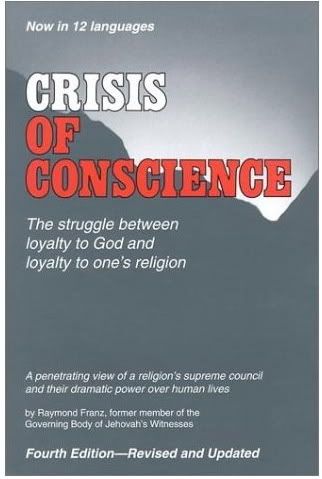
Book Review: "Crisis of Conscience" by Raymond Franz

Photo Sharing and Video Hosting at Photobucket


If you want a book that emphatically proves that the Watchtower is an unreliable organization, then this is your book. I can't imagine how any Jehovah's Witness can read this book and yet remain a member.

The author, Raymond Franz, was a Jehovah's Witness for most of his life as well as a governing body member. This is his story. He tells of how he became involved in full time service to the organization all the way up to his being disfellowshipped.

About half of the book is devoted to Franz's personal testimony and what he experienced as not only a full time staff member, but as a governing body member too. These are insights that very few men have chosen to reveal. This includes everything from the Society's scandelous cover-ups to the inner workings of the governing body.

What I found most valuable was Franz's allegations towards the Watchtower as a false prophet. Hundreds of pages were used to deal with the false prophecies of 1914 and 1975, as well as a few others.

Although the book is quite lengthy (over 400 pages), it is not a boring read. If you are interested in Jehovah's Witnesses, then you'll enjoy this book. Raymond Franz is a passionate writer and does everything he can to be fair. Very little is dealt with in regards to theology. In fact, Raymond Franz probably held and continues to hold to the core doctrines of the Watchtower. The entire thrust of the book is to stress the book's subtitle: "The struggle between loyalty to God and loyalty to one's religion." With this, i'll agree that Raymond Franz most certainly accomplished his purpose in writing this book.

Saturday, December 30, 2006

Desiring God

Photobucket - Video and Image Hosting


This is a sermon I did a few month ago on what it means to desire God. And I must give credit where credit is due; everything I said was borrowed from the book Desiring God by John Piper. If you could read one book that will change your life and your relationship with God more than any other Christian "inspirational" book ever could, this would be the one. Everything I say here is an extremely condensed version of the amazing depth Piper goes into in his book. Hope you enjoy!


In my first year of college, I decided to major in music. Did I choose music because my parents wanted me to? Did I choose it to make money? No. I chose music because I love music! I lived and breathed music! In high school I would spend hours upon hours practicing guitar. But when I went to college I didn’t find that everyone else had that same passion. And these were from people who had devoted their entire lives to music!

For instance, I loved my music theory classes. But all the other music majors hated it. At the very least you would think that they at least liked to practice their instruments. But no! They hated practicing! In fact, I couldn’t figure out if they even liked music at all! Were they in it because their parents made them? Surely not. What parent wants their kid to be a professional trumpet player? But maybe they were doing it for the money? Definitely not.

All I knew was that these people were pursuing music for the wrong reasons. Think of it like this; you and a friend are going to an art gallery to check out some of your favorite paintings. You notice that your friend is going from room to room paying very careful attention to each painting. This stirs your curiosity, so you ask, “What do you like so much about these paintings?” Your friend answers, “I’m trying to see how much money I could make off these if I were to buy and sell them.” So what’s wrong with this?

Your friend is looking at these paintings for the wrong reasons; he knows he can make a profit off them. But this was not the purpose of these paintings, is it? These paintings are be enjoyed aren't they? Or in other words, should we not pursue art for art’s sake, which in turn would be honoring it? But how do you honor art: you honor it by experiencing an appropriate emotion when you look at it.

And for some of us, we’ve been looking at God in a very similar way that the friend did in the art Gallery. We don’t give money to the church because we delight in it; we give money because it’s our duty. Its just something that we’re supposed to do. We don’t serve others because we delight in it; we serve others because it’s our duty. We sometimes don’t even worship God because we delight in it; we worship God because it’s our duty. Do you want to know what I think? I believe that delight is our duty! Therefore, if you are doing your duty, such as giving, and not gaining any pleasure from it, then you really aren’t doing your duty! In fact, I believe that the most important part of our very existence is to delight and enjoy God while seeking the pleasures that He offers us!

But what does it mean to enjoy God? Does this mean that we are to actually enjoy the things he has given us? And if so, does this mean that anything we enjoy must be good? These, as well as several other questions, I intend to get through tonight. And if you leave with one thing tonight and forget anything else I say, please remember this,

The chief end of man is to glorify God and enjoy Him forever

And I believe that if we, as Christians, abandon the pursuit of joy in the Creator of the Universe, we cannot do the will of God. I’ll repeat that again; if we, as Christians, abandon the pursuit of joy in the Creator of the Universe, we cannot do the will of God.

For too long, we have seen joy and delight as being mere icing on the cake. “As long as we serve God and perform our duties, then that’s enough!” But guys, if this is how we are living our lives then we are not doing what God intended us to do! God demands joy from us. He demands that we delight in Him. He demands that we seek pleasure in him. Or in other words, delight in God is not optional; it is essential!

So for the next few minutes, I want to share with you a truth that sets the foundation for the ultimate purpose of our existence, and that is the happiness of God. Have you ever wondered why God is happy? I believe that God is happy because he delights in Himself. And this is just the way it has to be. If God delighted in anything less than His own infinite glory, then that would make God imperfect would it not. In order for God to be God, he must be supremely delighted in Himself.

Another reason why God is happy is because of his sovereignty. Or in other words, God is supremely happy because He is completely in control. Psalm 115:3 says,

"Our God is in the heavens; He does whatever He pleases.”

Can you imagine what it would be like if God’s plan could be altered by human hands? First of all, if man could alter God’s ultimate plan, this verse would be not be true. And secondly, if man could alter God’s ultimate plan, then would this not make God unhappy? And that’s a very valid question to ask. We live in a sick and evil world! There is disease, war, and starvation! How could God possibly be happy in the midst of all this crap that goes on in the world?

Well, there are two things that help me with this. First, it doesn’t help to say that God is not really in control of what goes on in the world. For instance, if someone tried to comfort me after 9/11 by saying, “Mike, God didn’t will for this to happen. But you can still trust Him,” I would have responded by saying, “my comfort does not come from thinking that God is so weak that He couldn’t divert a few airplanes away from the twin towers.” You see, my God is completely sovereign and in control. He allowed all those people to die at His appointed time; and I believe that one day God will show me that His purpose in this was good.

So what do we do with this problem? I believe there are many solutions, but I will focus in on one that makes sense to me, although there are many other perspectives out there on this issue. God doesn’t delight in these evil events in and of themselves. I call this the narrow lens of God, where he focuses on these events that brings Him great grief and sorrow. But when God widens the lens, he sees these events through an eternal perspective.

A good example of this would be the story of Jesus Christ and His death on the cross. Was the crucifixion an evil event? Well, considering the fact that Jesus Christ was God in the flesh who lived a perfect life and was sentenced to the most torturous death imaginable, I would suggest this to be the most evil event of all time! But what about God? How did He view this? Think back to the narrow lens view. Was this event, in and of itself, an evil act? Most certainly. Everyone involved in the murder of Jesus was quite evil in their intentions and had no desire to bring glory to God. And not only that, but all those who were involved in this evil act were punished for it. But what about the wide lens, the eternal perspective of God? Was God ultimately happy as a result of what happened? Absolutely! For this was the very means by which God would demonstrate His righteousness and His love for mankind, to live a perfect live and die for their sins!

And certainly, more could be said about this, but I believe that no power or force in this world can alter or frustrate the plan of God because He delights infinitely in his own glory. And because he is in control and always does whatever He pleases, he is ultimately satisfied.

And this brings me to my last point. If what I said about God’s sovereignty weren’t true, then how could God be infinitely happy? Could you imagine what it would be like if the creator of the Universe weren’t happy? God would be distant; he would be frustrated; he could be impatient. And I don’t know about you, but I could not delight in a God who wasn’t infinitely delighted in Himself.

And here’s another way to look at it. In order for a sinner like me to pursue joy in God, I must be confident that He will not shut me out when I come to Him in seeking forgiveness and grace. And if that’s what you believe about God, let me assure you that this isn’t the God of the Bible. God shows love, mercy, and grace to us because He delights in showing love, mercy, and grace. In fact, God is so full of joy and life that it is His pleasure to overflow His joy on to us!

So when you go to work, school, or whatever it is you decide to do this week, remember that it is your duty to delight in God. And if you find yourself doing things out of pure obedience, such as singing worship songs when you don’t feel like worshiping, ask God to bring you joy. Don’t just do it for the sake of doing it. It matters how you feel! I can show you hundreds of Scriptures that speak of us delighting in worship, giving with a cheerful heart, serving with pleasure as our goal. And if you don’t carry these emotions, then ask God to change your heart. Do you really think God is going to reject your request if He is most glorified when you are most delighted in Him? Of course not! God wants your affections. He wants your joy. He wants your happiness.

Monday, December 04, 2006

A review of "The Potter's Freedom" by James White

Photobucket - Video and Image Hosting

If I had to choose any modern text to defend the doctrines of grace, it would be "The Potter's Freedom" by James White. Well over 6 years ago, Dr. Norman Geisler wrote a book called "Chosen but Free." At first glance, one might think that "chosen but free" might be a defense of Calvinism, hence the word "chosen." But what James White effectively demonstrates is that Dr. Geisler will have nothing to do with what he called, "extreme Calvinism." But because I haven't read Dr. Geislers book, thus rendering it unfair for me to comment on it, I will choose not to comment on James' refutations. Fortunately, "The Potter's Freedom" is more than a refutation of "Chosen but Free," but a defense of the Reformation.

Many protestants (particularly baptists) are unfamiliar with their roots. If you fit into this category, it would be of much interest for you to find out where you came from. Most people who have had any kind of History course knows enough about the Reformation to know that the Catholic Church split as a result of Martin Luther. But little do they know what started all the controversy. Was it over the sacraments? Indulgences? The Mass? Purgatory? No. It was a debate between Luther and Erasemus over the depravity of man. In fact, Luther wrote a book called "The bondage of the will" which is still in print today. In it, Luther discusses the fact that man is enslaved to sin and incapable of generating saving faith within himself. Therefore, something needs to happen that is out of man's control!

This is where God comes into the picture. God saves us because we are incapable of saving ourselves! It is more than mere cooperation between God and man; God alone saves. This is one of the major themes in Dr. White's book. Dr. Geisler presents a man-centered gospel while James White proclaims a God-centered one. Dr. Geisler believes that God didn't actually come to save, but to make salvation only a possibility. Is this what the Bible teaches? Or is God a powerful savior who saves perfectly without fail?

The introduction of the book is primarily devoted to the question, "Why write such a book?" Obviously, Dr. Geisler is highly respected among Christian apologists and scholars, so James White seeks to explain why he wrote this book. One of the foremost reasons is because James White loves the truth. Because Dr. Geisler is on such a high ranking among scholars, he should be held only to the highest standards of scholarship. Unfortunately, Dr. Geisler has failed to represent Calvinism correctly in most of his arguments. Therefore, James White felt the need to respond to "chosen but free." And i'm thankful he did, because the result was an outstanding work of biblical scholarship! But even if you haven't read Dr. Geisler's book, I would still recommend "The Potter's Freedom," as it is a defense of the Reformation and the Doctrines of Grace. In fact, I know of no single book which addresses the subject of Calvinism in such a scholarly, in-depth way than "The Potter's Freedom" does.

***This is the same review that appears on my Amazon.com book review Site