Unless you haven't left your room, turned on your tv, signed on the internet, or have been camping for the past week, you've probably heard the news that some have claimed to have found the tombs of Jesus and his family. And not only that, but they've supposedly identified, using DNA experimentation, Jesus' body.
Its not my attention to attempt to refute this idea just yet, even though a large portion of the evidences rely on a so-called 15th century forgery called The Acts of Phillip. And I must admit that it is very tempting to do a full launch refutation of this "theory," because although the film hasn't yet been aired (airs this Sunday), and because I haven't read the book (just released Tuesday, which should be arriving to my home any day now), it would simply be unfair and even risky to do.
And fortunately, many have already attempted some very fine rebuttals of this theory. This is probably the best thing we have available that refutes many of the pre-film claims. If you aren't a big reader, go to that link and listen to the program. But if you are a reader, go here.
I am currently very close to finishing my studies in textual criticism and KJonlyism (not finished, but you know what I mean), and I was intending to write an in-depth blog on the subject in addition to one on the deity of Christ (believe it or not, but the KJV and the deity of Christ are very closely related). But unfortunately, this issue is just too big to ignore.
If you are a believer in Christ, this issue could very well mean the end of Christianity. If Jesus' bones were to be found, its over; we have nothing left. And sadly, the outcome of this theory might destroy the faith of many. And you might argue, as many did with the Da Vinci Code, "If their faith is shaken because of this, maybe they don't have genuine faith?" I understand this concern. But aren't we to care for the flock, both the weak and the strong? I believe we should. And I believe that Christians have more reason now than ever before to be concerned with this stuff.
So I don't know about you, but I'm going to watch the show on Sunday. And i'm going to read the book as soon as it arrives. I'm going to do my homework. And i'm going to write a full rebuttal of this "theory" as soon as time allows. What are you going to do?
Wednesday, February 28, 2007


Saturday, February 24, 2007
Greek/Hebrew dictionaries and lexicons corrupt?
"There are no safe and reliable sources available today, outside of the Holy Bible, that can be used for Bible study or translation work."
"Those who use new lexicons and new versions need to be aware of the men who are behind the ‘new meanings’ in them. Their authors revolted against the traditional translation of the Bible and sought to replace it with ‘new meanings’ for Greek and Hebrew words."
"Hebrew and Greek lexicons and grammars are not only unsafe, they are unnecessary. If they were a “need” (Phil. 4:19), God would make good lexicons available."
"All available lexical tools, which would be the means of ‘reading’ these Greek and Hebrew texts, are corrupt."
Interesting statements, huh? Who are they from? None other than King James Only advocate Gail Riplinger in her recent newsletter. If you are unfamiliar to the KJonly debate, the quotes above might come as a shocker. But to sum it up, Gail Riplinger believes that the King James Bible is the only inspired, innerant Word of God. This means that all "new" Bible versions, such as the NIV, NASB, and even the NKJV are corrupt.
My current studies are in the areas of textual criticism and the King James only debate. Many people may wonder why anyone would want to get involved in such things? To be honest, I wish I didn't have to get involved. But sadly, this issue is not only tearing apart churches, but it is causing believers to doubt that God's Word has been preserved. And when I read this newsletter, I was saddened in realizing that thousands and thousands of people are in full support of Gail Riplinger's position. And although I am well aware at what Gail Riplinger believes, I was completely shocked at some of the things her newsletter said. I had no idea that King James onlyists were arguing that even the Greek/Hebrew dictionaries and lexicons were corrupt. Think about what this means; Gail Riplinger wants us to believe that we can have no idea as to what Greek texts the KJV translators were translating from. You see, Gail Riplinger believes that the King James translation is a new revelation from God. And because of this, she automatically has to reject anything that is not the King James Bible. Why? Because it isn't God's preserved Word! And it strikes me as ironic that Gail is forced to come to these conclusions. And the reason is simple; the King James Bible is not a perfect translation in any way, shape or form. It has mistakes. Words were mistranslated and it was based on inferior manuscripts. And because of this, Gail Riplinger is forced to take her position to its only conclusion: everything else is corrupt; all the godly men involved in the painstaking work of providing us with language tools to check our Bibles in the original languages are dismissed as heretics.
I don't want to go into too much depth on this subject, but I want people to be aware at what's going on. I have a lot more research to do before I write an in-depth blog on the subject. But I intend to in the next few months. God bless you all! And if you have any questions about this issue, feel free to ask.
"Those who use new lexicons and new versions need to be aware of the men who are behind the ‘new meanings’ in them. Their authors revolted against the traditional translation of the Bible and sought to replace it with ‘new meanings’ for Greek and Hebrew words."
"Hebrew and Greek lexicons and grammars are not only unsafe, they are unnecessary. If they were a “need” (Phil. 4:19), God would make good lexicons available."
"All available lexical tools, which would be the means of ‘reading’ these Greek and Hebrew texts, are corrupt."
Interesting statements, huh? Who are they from? None other than King James Only advocate Gail Riplinger in her recent newsletter. If you are unfamiliar to the KJonly debate, the quotes above might come as a shocker. But to sum it up, Gail Riplinger believes that the King James Bible is the only inspired, innerant Word of God. This means that all "new" Bible versions, such as the NIV, NASB, and even the NKJV are corrupt.
My current studies are in the areas of textual criticism and the King James only debate. Many people may wonder why anyone would want to get involved in such things? To be honest, I wish I didn't have to get involved. But sadly, this issue is not only tearing apart churches, but it is causing believers to doubt that God's Word has been preserved. And when I read this newsletter, I was saddened in realizing that thousands and thousands of people are in full support of Gail Riplinger's position. And although I am well aware at what Gail Riplinger believes, I was completely shocked at some of the things her newsletter said. I had no idea that King James onlyists were arguing that even the Greek/Hebrew dictionaries and lexicons were corrupt. Think about what this means; Gail Riplinger wants us to believe that we can have no idea as to what Greek texts the KJV translators were translating from. You see, Gail Riplinger believes that the King James translation is a new revelation from God. And because of this, she automatically has to reject anything that is not the King James Bible. Why? Because it isn't God's preserved Word! And it strikes me as ironic that Gail is forced to come to these conclusions. And the reason is simple; the King James Bible is not a perfect translation in any way, shape or form. It has mistakes. Words were mistranslated and it was based on inferior manuscripts. And because of this, Gail Riplinger is forced to take her position to its only conclusion: everything else is corrupt; all the godly men involved in the painstaking work of providing us with language tools to check our Bibles in the original languages are dismissed as heretics.
I don't want to go into too much depth on this subject, but I want people to be aware at what's going on. I have a lot more research to do before I write an in-depth blog on the subject. But I intend to in the next few months. God bless you all! And if you have any questions about this issue, feel free to ask.
Saturday, February 17, 2007
Review of "Misquoting Jesus" by Bart Ehrman
This is the review I did recently for Amazon.com :
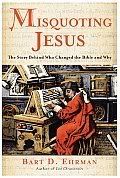
When I first heard about this book I was excited. Finally, a well-researched book on textual criticism written for laymen! Although I was well aware of Ehrman's liberal views, I didn't think this would affect the factual and historical issues related to this subject; and it didn't. Bart Ehrman may very well be one of the foremost authorities on this subject alive today. And I think those who dismiss Ehrman's work without reading it need to give him more credit.
One thing I learned from this book is that liberals CAN do research. I don't care how conservative you are (I am very conservative myself), the historical and factual observations in this work are to be commended. And this brings up a very important point: fundamentalists (in any sense of the word) should not automatically dismiss the work of unbelievers. Too often I encounter those who refuse to buy or even read books like "Misquoting Jesus" simply because they would be "supporting the anti-Christian work of unbelievers." Does Bart Ehrman present conclusions in his books that are simply exaggerated and unreasonable? Yes. Does this mean we should conclude that Bart Ehrman is an apostate who can't do good historical research? No.
The first 5 chapters of this book were excellent. They were based upon true historical research and were almost completely void of Ehrman's presuppositional conclusions that we find in the concluding chapter. I really appreciated the introductory chapter because it allowed the reader to understand exactly where Ehrman was coming from. In no way would the reader be able to start this work and be deceived into thinking that the author was somehow hiding his bias. For example, we read on page 11,
"If one wants to insist that God inspired the very words of scripture, what would be the point if we don't have the very words of scripture...for I came to realize that it would have been no more difficult for God to preserve the words of scripture than it would have been for him to inspire them in the first place. If he wanted his people to have his words, surely he would have given them to them (and possibly even given them the words in a language they could understand, rather than Greek and Hebrew). The fact that we don't have the words surely must show, I reasoned, that he did not preserve them for us. And if he didn't perform that miracle, there seemed to be no reason to think that he performed the earlier miracle of inspiring those words."
I think anyone reading Erhman's words here can see where he is coming from. In essence, he is saying, "unless God transmits the scriptures in a way that is in accordance with my presuppositions, they couldn't possibly have been inspired." Can you imagine the implications of this view? Think about what it would be like if the scriptures were transmitted in the way that Erhman would have preferred;
Take, for example, a monk who is copying the gospel of John. It is about 20 degrees outside and his fire is about to go out. And not only that, but the last meal he ate was about 12 hours ago. His hands are shaking. He is tired. It is late. He knows that if he doesn't get this done tonight...well, it better get finished. Then it happened...he is so exhausted that he accidentally skips a line because it looked so much like the previous one (yes, this happens to all of us...even on computers). And then, "ZZAAPPP!!!!!!" Lightening from the heavens strikes him dead. If this copy of the Gospel of John had been released, then we would have had...yes friends, you guessed correctly, a textual variant!
No matter how easy it would be to dismiss the variant as a simple copyist error, this couldn't happen if Bart Ehrman's view on "inspiration" is true. Do you see the implications of this? God would have to either strike every monk dead who accidentally misspelled a word or copied a line twice, or he would have to temporarily turn them into human dictation machines (now think about THAT!).
Now, I want to be fair to Ehrman. If it weren't for the so-called "theologically motivated alterations" of the texts (such as Luke 5:43-44, according to Ehrman), I don't think that his view on inspiration wouldn't be as radical as they are. But because these changes could have happened (or did happen according to Ehrman), it couldn't be the way God wanted to do it. And it must be emphasized that in the vast majority of cases we know what the original reading was, whether or not the variant was accidental or intentional. So in most of these cases the question is not, "what did the original texts say," but, "was the change accidental or intentional?"
I felt that Ehrman was quite fair in dealing with these variants, but what I don't understand is this; if Bart Erhman believes that it is at least possible to know what the original authors wrote (he claims on p. 210, "A number of scholars...have even given up thinking that it makes sense to talk about the 'original' text. I personally think that opinion may be going too far...so at least it is not "non"-sense to talk about an original text."), why should we conclude that God couldn't have inspired these books? Yes, God used fallible men to copy the scriptures. But isn't it remarkable that in at least 99 percent of the cases (its probably a lot higher, but I'll be generous to the liberals), and out of over 5,000 Greek manuscripts, we know with complete certainty what the original authors wrote down? In addition, those places where it is difficult to determine the original reading, we must keep in mind that we HAVE the original reading; it's in the texts. We just have to choose which text has the original reading.
So the next time someone tells you, "show me the writings of Paul," just pull out a Nestle-Aland 27th edition and a United Bible Society 4th edition Greek New Testament and hand it to him or her. The original writings of Paul are there. We just have to determine what they are (which I must emphasize again; we KNOW what they are AT LEAST 99 percent of the time).
Now, I want to come back to something I mentioned earlier. Many Christians are ignorant, willingly or unintentionally, of these issues. If you see "Misquoting Jesus" as complete trash that shouldn't be read by Christians, then you either a) haven't read the book, or b) are ignorant of textual criticism. Yes, Bart Ehrman's conclusions are far fetched and his presuppositions completely unreasonable. But this makes up a very small percentage of the book. The rest is very excellent, well researched history (and well written, I might add). With this, I want to conclude this review on an encouraging note Christians who are un-informed on this issue.
So let's face it, many of us don't know how we got the Bible. We like to believe that our leather-bonded NIV study Bible magically fell from the heavens into your friendly neighborhood Christian bookstore. We don't like to believe that most Christians in the early church didn't have complete Bibles (considering it was very expensive and often times illegal) and that the copying process was done by hand in a very painstaking way. With this we can somewhat sympathize with Ehrman; if God miraculously inspired the original writings of the texts, why couldn't he have miraculously transmitted them as well (some actually believe that God did this in the King James version of the Bible)? Could Erhman be right? If he is wrong, then why is he wrong?
If you are a Christian, ask yourself, "where did my NIV study Bible come from? Does it matter?" Should you simply trust those who translated your Bible; that they were infallible in choosing which variant readings were the best? How do YOU know that your Bible contains the original readings? For example, how many times have you heard a sermon preached on the woman being caught in adultery (John 8:3-11) with Jesus forgiving her? Bart Ehrman and many other scholars (some even conservative) have concluded that this story wasn't the original reading. Or how about 1 John 5:7, which reads, "For there are three that bear record in heaven, the Father, the Word, and the Holy Ghost: and these three are one." Try to find this verse in your NIV; it's not there. But it's in the KJV. Why? This verse clearly attests to the Trinity. Does it matter if God is three persons that share one being? King James onlyists insist that the King James Bible is God's very words preserved for us in the English language and that all "new" versions, such as the NIV, are corrupt. Are they right? Do you see the implications?
Books like "Misquoting Jesus" are very important and contain information that every Christian needs to be concerned about. So I just want to encourage you, Christian or not, to look into these issues. You don't have to have a Master's degree in Greek exegesis to be informed on these issues. All you need is a desire to study. Don't take my word for it. Don't take Bart Ehrman's word for it. Don't take the KJV translator's word for it. And don't take your pastor's word for it. Study this issue for yourself. The implications and consequences may be eternal.
When I first heard about this book I was excited. Finally, a well-researched book on textual criticism written for laymen! Although I was well aware of Ehrman's liberal views, I didn't think this would affect the factual and historical issues related to this subject; and it didn't. Bart Ehrman may very well be one of the foremost authorities on this subject alive today. And I think those who dismiss Ehrman's work without reading it need to give him more credit.
One thing I learned from this book is that liberals CAN do research. I don't care how conservative you are (I am very conservative myself), the historical and factual observations in this work are to be commended. And this brings up a very important point: fundamentalists (in any sense of the word) should not automatically dismiss the work of unbelievers. Too often I encounter those who refuse to buy or even read books like "Misquoting Jesus" simply because they would be "supporting the anti-Christian work of unbelievers." Does Bart Ehrman present conclusions in his books that are simply exaggerated and unreasonable? Yes. Does this mean we should conclude that Bart Ehrman is an apostate who can't do good historical research? No.
The first 5 chapters of this book were excellent. They were based upon true historical research and were almost completely void of Ehrman's presuppositional conclusions that we find in the concluding chapter. I really appreciated the introductory chapter because it allowed the reader to understand exactly where Ehrman was coming from. In no way would the reader be able to start this work and be deceived into thinking that the author was somehow hiding his bias. For example, we read on page 11,
"If one wants to insist that God inspired the very words of scripture, what would be the point if we don't have the very words of scripture...for I came to realize that it would have been no more difficult for God to preserve the words of scripture than it would have been for him to inspire them in the first place. If he wanted his people to have his words, surely he would have given them to them (and possibly even given them the words in a language they could understand, rather than Greek and Hebrew). The fact that we don't have the words surely must show, I reasoned, that he did not preserve them for us. And if he didn't perform that miracle, there seemed to be no reason to think that he performed the earlier miracle of inspiring those words."
I think anyone reading Erhman's words here can see where he is coming from. In essence, he is saying, "unless God transmits the scriptures in a way that is in accordance with my presuppositions, they couldn't possibly have been inspired." Can you imagine the implications of this view? Think about what it would be like if the scriptures were transmitted in the way that Erhman would have preferred;
Take, for example, a monk who is copying the gospel of John. It is about 20 degrees outside and his fire is about to go out. And not only that, but the last meal he ate was about 12 hours ago. His hands are shaking. He is tired. It is late. He knows that if he doesn't get this done tonight...well, it better get finished. Then it happened...he is so exhausted that he accidentally skips a line because it looked so much like the previous one (yes, this happens to all of us...even on computers). And then, "ZZAAPPP!!!!!!" Lightening from the heavens strikes him dead. If this copy of the Gospel of John had been released, then we would have had...yes friends, you guessed correctly, a textual variant!
No matter how easy it would be to dismiss the variant as a simple copyist error, this couldn't happen if Bart Ehrman's view on "inspiration" is true. Do you see the implications of this? God would have to either strike every monk dead who accidentally misspelled a word or copied a line twice, or he would have to temporarily turn them into human dictation machines (now think about THAT!).
Now, I want to be fair to Ehrman. If it weren't for the so-called "theologically motivated alterations" of the texts (such as Luke 5:43-44, according to Ehrman), I don't think that his view on inspiration wouldn't be as radical as they are. But because these changes could have happened (or did happen according to Ehrman), it couldn't be the way God wanted to do it. And it must be emphasized that in the vast majority of cases we know what the original reading was, whether or not the variant was accidental or intentional. So in most of these cases the question is not, "what did the original texts say," but, "was the change accidental or intentional?"
I felt that Ehrman was quite fair in dealing with these variants, but what I don't understand is this; if Bart Erhman believes that it is at least possible to know what the original authors wrote (he claims on p. 210, "A number of scholars...have even given up thinking that it makes sense to talk about the 'original' text. I personally think that opinion may be going too far...so at least it is not "non"-sense to talk about an original text."), why should we conclude that God couldn't have inspired these books? Yes, God used fallible men to copy the scriptures. But isn't it remarkable that in at least 99 percent of the cases (its probably a lot higher, but I'll be generous to the liberals), and out of over 5,000 Greek manuscripts, we know with complete certainty what the original authors wrote down? In addition, those places where it is difficult to determine the original reading, we must keep in mind that we HAVE the original reading; it's in the texts. We just have to choose which text has the original reading.
So the next time someone tells you, "show me the writings of Paul," just pull out a Nestle-Aland 27th edition and a United Bible Society 4th edition Greek New Testament and hand it to him or her. The original writings of Paul are there. We just have to determine what they are (which I must emphasize again; we KNOW what they are AT LEAST 99 percent of the time).
Now, I want to come back to something I mentioned earlier. Many Christians are ignorant, willingly or unintentionally, of these issues. If you see "Misquoting Jesus" as complete trash that shouldn't be read by Christians, then you either a) haven't read the book, or b) are ignorant of textual criticism. Yes, Bart Ehrman's conclusions are far fetched and his presuppositions completely unreasonable. But this makes up a very small percentage of the book. The rest is very excellent, well researched history (and well written, I might add). With this, I want to conclude this review on an encouraging note Christians who are un-informed on this issue.
So let's face it, many of us don't know how we got the Bible. We like to believe that our leather-bonded NIV study Bible magically fell from the heavens into your friendly neighborhood Christian bookstore. We don't like to believe that most Christians in the early church didn't have complete Bibles (considering it was very expensive and often times illegal) and that the copying process was done by hand in a very painstaking way. With this we can somewhat sympathize with Ehrman; if God miraculously inspired the original writings of the texts, why couldn't he have miraculously transmitted them as well (some actually believe that God did this in the King James version of the Bible)? Could Erhman be right? If he is wrong, then why is he wrong?
If you are a Christian, ask yourself, "where did my NIV study Bible come from? Does it matter?" Should you simply trust those who translated your Bible; that they were infallible in choosing which variant readings were the best? How do YOU know that your Bible contains the original readings? For example, how many times have you heard a sermon preached on the woman being caught in adultery (John 8:3-11) with Jesus forgiving her? Bart Ehrman and many other scholars (some even conservative) have concluded that this story wasn't the original reading. Or how about 1 John 5:7, which reads, "For there are three that bear record in heaven, the Father, the Word, and the Holy Ghost: and these three are one." Try to find this verse in your NIV; it's not there. But it's in the KJV. Why? This verse clearly attests to the Trinity. Does it matter if God is three persons that share one being? King James onlyists insist that the King James Bible is God's very words preserved for us in the English language and that all "new" versions, such as the NIV, are corrupt. Are they right? Do you see the implications?
Books like "Misquoting Jesus" are very important and contain information that every Christian needs to be concerned about. So I just want to encourage you, Christian or not, to look into these issues. You don't have to have a Master's degree in Greek exegesis to be informed on these issues. All you need is a desire to study. Don't take my word for it. Don't take Bart Ehrman's word for it. Don't take the KJV translator's word for it. And don't take your pastor's word for it. Study this issue for yourself. The implications and consequences may be eternal.
Subscribe to:
Posts (Atom)

 Posts
Posts


