Watch this video and be amazed at the hypocritical inconsistencies of "Bishop" Spong. Many liberals like to throw out criticisms of "the church made this up" and "the church made that up." But then what do these very same liberals conclude with? "But God really isn't like that, he's really like this." My question is, how does he know? This video gave me a full-on epistemological headache.
Showing posts with label Liberal Theology. Show all posts
Showing posts with label Liberal Theology. Show all posts
Tuesday, August 24, 2010


Tuesday, April 20, 2010
Michael Brown vs. Bart Ehrman: Debate on suffering and the Bible

When we hear the name "Bart Ehrman," those who are familiar with him know that he is a textual critic as well as a historian. I never thought of him as a theologian nor as a philosopher. But Bart Ehrman is certainly notorious for crossing those lines both in print and in debate. And this event was no exception. Recently, Ehrman released a book on suffering. This came to me as a surprise for one who's expertise was in the realm of textual criticism. But once we realize that Ehrman does, in fact, have a theological background (as well as experience in teaching on this very subject), we should not be so quick to dismiss Ehrman in going outside his field of expertise.
At any rate, in this debate, we get to have an inside look at what Bart Ehrman really feels about God. It was Bart Ehrman's position to articulate why he didn't believe the Bible presents an adequate answer to the "problem" of suffering. And to the opposite, it was Michael Brown's job to defend the Bible. With the exception of his recent encounters with James White on the subject of Calvinism, I knew very little about Dr. Brown other than his books on answering Jewish objections to Jesus. And though Michael Brown is more arminian than calvinistic, I thought he did a really good job in defending his position. However, like most who debate Ehrman, Brown was far from "mopping the floor" with him. And i'll explain why.
When we try to explain suffering, we can do so through two categories of "why's." There is the primary category, where we explain the big picture reality, and the secondary category, where we explain the immediate reality. Biblically, the big picture of why we have suffering is based on one simple reason: Adam sinned. And according to Genesis 3 and Romans 8, all of creation is affected by the curse. Though Brown certainly alluded to this here and there, I am baffled as to why this wasn't the central theme of Brown's thesis. Don't get me wrong though. I think Brown did a good job of answering Ehrman's arguments. But I still think that Genesis presents the best big picture response to any "suffering" objection that the skeptic can thrown our way.
For example, Ehrman argued that the Bible presents such contradictory "answers" to suffering, that we can't really know why there is suffering. For instance, in Amos and the other prophets, there is suffering because God is directly punishing people for their sins. But in books like Job, there is suffering because God is "teaching a lesson." Therefore, when we look at tragedies like the earthquake in Haiti, is God punishing them for their sins, or teaching them a lesson? According to Ehrman, we simply cannot know based on the Bible.
I think that Brown did a good job of answering these objections specifically, but didn't spend enough time on the big picture. Wouldn't it have been easier to say, "In the case of Job and the minor prophets, or any other reason the Bible presents for suffering, the bottom line is; anyone and everyone suffers because Adam sinned and brought a curse into this world." Problem solved. Ehrman can bring as many "contradictory" reasons that he wants for suffering in the Bible, but they all stem from the fall in Genesis 3.
Next, I thought Michael Brown could have spent a lot more time addressing Ehrman's epistemology. How does Ehrman know what he knows? Why does Ehrman believe there is such a thing as right and wrong, good and evil? And what is his basis for believing as such? Ehrman offered the usual line of reasoning, "Suffering is wrong because it causes people harm. And we define what is good and evil based on that." Brown should have hammered him hard on this point. The reason being, Ehrman's worldview is easily dismantled when it is shown for what it really is: matter in motion. Ehrman is an agnostic, but more specifically an atheist when he claims to "not believe in God." And if there is no God, then we are nothing more than globs of protoplasm wondering around in a universe that is nothing more than atoms banging around. In this worldview, how in the world can one define "suffering" or "evil?" Ehrman defends his view as if "suffering" is some sort of objective thing. But his worldview gives no basis in which one can objectively define good and evil. That is, some societies feel that is best to love one's neighbor. But others feel that it is best to eat one's neighbor. It is my conviction that Brown could have hit a home run if he would have elaborated more on this point.
Overall, this was a great debate. Both speakers are articulate and passionate. And though Brown is not Reformed, I believe that this topic could have been addressed and defended from either side by sticking to Genesis and moral epistemology. But because Brown didn't, most reformed folk will have disagreed with his approach. And perhaps this could be one complaint that I have with many reformed theologians: they would bring God's sovereignty into the picture when there isn't necessarily a reason for doing so. After all, in Genesis 3, the issue of God's sovereignty isn't even brought up. And this means that though there might be inconsistencies in either position, I feel that one could adequately defend the Bible on the problem of suffering without even going there.
You can listen to the entire debate HERE
(ht: Apologetics 315)
Thursday, October 01, 2009
James White vs. Dan Barker on the proposition: The Jesus Story is Cut from the Same Story as Other Ancient Mythologies

Recently, Christian apologist James White debated Dan Barker on the topic above. Anyone who has seen the internet film Zeitgeist and other "popular atheist media" has probably heard the objection that Christianity is not unique and, in fact, has borrowed its stories from pagan mythology. Therefore, as the objection goes, Christianity is probably not true. This debate is pretty unique in that i'm not aware of one that has centered around this particular proposition. I think anyone interested in the historicity of the Christian Scriptures will find this debate very informative.
You can download the mp3 of the debate HERE
You can watch the debate HERE
Also, there was a very interesting part of the debate, where Barker interrupts White for quoting his book, that can be found HERE
(ht: Apologetics315)
Saturday, May 23, 2009
Friday, April 10, 2009
Bart Ehrman on the Colbert show
Ehrman vs. Colbert. I think Colbert won. What do you think?
ht: James White
| The Colbert Report | Mon - Thurs 11:30pm / 10:30c | |||
| Bart Ehrman | ||||
| ||||
ht: James White
Saturday, March 24, 2007
The Jesus Family Tomb: CASE CLOSED
I just finished reading "The Jesus Family Tomb," and I can say with confidence: THE CASE IS CLOSED. There is absolutely no substantial evidence to support Jacobovici's claims. The book is a historical, scientific, and statistical nightmare. Bold claims are made without any substantiation; facts are left out; scholars are quoted out of context. This was just another poorly researched book that might end up making millions but will soon meet its misery when people take 15 minutes to look up the facts for themselves. I don't want to write a full critique right now for two reasons:
1) I don't have time
2) James White has written a soon-to-be-released book refuting The Jesus Family Tomb.
"But Mike! I thought you said the case was closed! Why wait?" Yes, the case most definitely is closed. In fact, I feel confident that I could write a deathblow critique of the theory. But if it weren't for the sake of integrity, I would do it. You see, The Jesus Family Tomb theory wasn't properly researched. Very few, if any, peer reviewed journal articles have been written on the subject. Therefore, we are left with very little to work with in writing scholarly refutations of the work. But I will go ahead and make this prediction; in less than one year, enough scholarly material will have been published on this issue to completely destroy Jacobovici's (and possibly James Cameron's) credibility.
This is why i'm waiting on James White's book. He has actually corresponded with the scholar's and scientists that Jacobovici has referenced in his book and the film. These correspondences are not essential, but very valuable.
But just for the sake of integrity, I feel that I am very well equipped to handle any defense of the Jesus Tomb. So if you have objections to anything i've said, or feel that you can actually defend Jacobovici's theory, then I challenge you to support your claims.
In the meantime, I thought i'd post a summary of the errors (Found on James White's blog) so that you'd have something to chew on until I write a full refutation:
- The book and film were not subjected to serious scholarly examination prior to release to the public.
· Many scholars cited in the film and book have affirmed that they were not told the full story, and that their statements have been used out of context.
· The theory uses double standards in its tremendously inconsistent use of the New Testament, at times accepting its accuracy on one point, then rejecting it on the next, without following any logical standards.
· The film and book demonstrate a consistent willingness to document only particular facts related to its conclusions, ignoring those facts that are contrary to its conclusions.
· The central argument of the film (that Mariamne is the original name of Mary Magdalene) is subject to numerous counter-arguments and explanations.
· The inscription on the Mariamne ossuary can be read at least three ways, and the first two, which leave the entire theory without any ground, are more likely than the third, upon which the theory depends.
· Even taking the inscription as the theory does, there is no reason whatsoever to believe a fourth century work of fiction, The Acts of Philip, is relevant to first century Jerusalem.
· The Acts of Philip nowhere refers to, or identifies Mariamne as, Mary Magdalene. The name Mary Magdalene never appears in The Acts of Philip.
· The Acts of Philip say Mariamne could turn into an ark of glass and a pillar of fire. Do the theorists think Mary Magdalene could do this?
· The film misrepresents Francois Bovon of Harvard who has confirmed that he is only referring to the Mariamne/Magdalene connection in the realm of literary parallels, not history.
· Bovon refers to the theorys claims that Jesus and Mary Magdalene had a child as "science fiction."
· The film misrepresents even the existing text of The Acts of Philip by saying the book says Mary Magdalene (which it never mentions) would be buried in Jerusalem. It actually says Mariamne would die in the Jordan River (which does not flow through Jerusalem).
· The theory's willingness to abandon first century documents directly related to Jesus and his original followers (the New Testament) in favor of a work of fiction from the Encratite community of Asia Minor three hundred years later is a clear indication of its bias.
· The film and book misrepresent the nature and capacities of forensic mitochondrial DNA testing.
· Simcha Jacobovici claims Carney Matheson concluded that the genetic testing shows Yeshua bar Yosef and Mariamne were married. Matheson denies this conclusion forcefully.
· Mitochondrial DNA testing can only address maternal relationships, not paternal ones. Hence, the two genotypes tested could have included a father/daughter relationship, a fact inexplicably left out of the discussion by the film and book.
· The names of Jesus, Mary, Joseph, etc., have been found in other burial sites in Jerusalem in the past, including Dominus Flevit.
· All of the names in the Talpiot tomb are found amongst the top ten most popular names for men and women in the time period of the first century in Jerusalem.
· The argument that there is at least a 600:1 chance that this is the Jesus family tomb is based upon the assumption that 1) there is a Jesus family tomb in Jerusalem, and 2) it has been found. That is, the statistical argument assumes its own conclusion so as to have validity!
· There is no reason whatsoever to believe Jesus would own a multi-generational tomb in Jerusalem. He was from Nazareth, 120 miles to the north, in Galilee, and only visited Jerusalem.
· The theories propounded in the book concerning the Knights Templar are presented without even the pretense of factual or historical foundation, and as such, have as much validity as The Da Vinci Code. They are pure fiction.
· The alleged cross symbol on the Jesus ossuary is far more likely the simple "this side forward" mark to indicate which way to slide the lid so that it would fit.
· The idea that the Judah, son of Jesus in the Talpiot tomb, is the author of the Gospel of Thomas, which was written in AD 165, a century after the Talpiot tomb was sealed, is emblematic of the kind of scholarship represented in The Family Tomb of Jesus.
· The film and book desperately seek to avoid honestly stating the only possible ramification of their theory: that Christianity's primary claim in the resurrection of Jesus Christ is false, and hence Christianity is a false religion.
1) I don't have time
2) James White has written a soon-to-be-released book refuting The Jesus Family Tomb.
"But Mike! I thought you said the case was closed! Why wait?" Yes, the case most definitely is closed. In fact, I feel confident that I could write a deathblow critique of the theory. But if it weren't for the sake of integrity, I would do it. You see, The Jesus Family Tomb theory wasn't properly researched. Very few, if any, peer reviewed journal articles have been written on the subject. Therefore, we are left with very little to work with in writing scholarly refutations of the work. But I will go ahead and make this prediction; in less than one year, enough scholarly material will have been published on this issue to completely destroy Jacobovici's (and possibly James Cameron's) credibility.
This is why i'm waiting on James White's book. He has actually corresponded with the scholar's and scientists that Jacobovici has referenced in his book and the film. These correspondences are not essential, but very valuable.
But just for the sake of integrity, I feel that I am very well equipped to handle any defense of the Jesus Tomb. So if you have objections to anything i've said, or feel that you can actually defend Jacobovici's theory, then I challenge you to support your claims.
In the meantime, I thought i'd post a summary of the errors (Found on James White's blog) so that you'd have something to chew on until I write a full refutation:
- The book and film were not subjected to serious scholarly examination prior to release to the public.
· Many scholars cited in the film and book have affirmed that they were not told the full story, and that their statements have been used out of context.
· The theory uses double standards in its tremendously inconsistent use of the New Testament, at times accepting its accuracy on one point, then rejecting it on the next, without following any logical standards.
· The film and book demonstrate a consistent willingness to document only particular facts related to its conclusions, ignoring those facts that are contrary to its conclusions.
· The central argument of the film (that Mariamne is the original name of Mary Magdalene) is subject to numerous counter-arguments and explanations.
· The inscription on the Mariamne ossuary can be read at least three ways, and the first two, which leave the entire theory without any ground, are more likely than the third, upon which the theory depends.
· Even taking the inscription as the theory does, there is no reason whatsoever to believe a fourth century work of fiction, The Acts of Philip, is relevant to first century Jerusalem.
· The Acts of Philip nowhere refers to, or identifies Mariamne as, Mary Magdalene. The name Mary Magdalene never appears in The Acts of Philip.
· The Acts of Philip say Mariamne could turn into an ark of glass and a pillar of fire. Do the theorists think Mary Magdalene could do this?
· The film misrepresents Francois Bovon of Harvard who has confirmed that he is only referring to the Mariamne/Magdalene connection in the realm of literary parallels, not history.
· Bovon refers to the theorys claims that Jesus and Mary Magdalene had a child as "science fiction."
· The film misrepresents even the existing text of The Acts of Philip by saying the book says Mary Magdalene (which it never mentions) would be buried in Jerusalem. It actually says Mariamne would die in the Jordan River (which does not flow through Jerusalem).
· The theory's willingness to abandon first century documents directly related to Jesus and his original followers (the New Testament) in favor of a work of fiction from the Encratite community of Asia Minor three hundred years later is a clear indication of its bias.
· The film and book misrepresent the nature and capacities of forensic mitochondrial DNA testing.
· Simcha Jacobovici claims Carney Matheson concluded that the genetic testing shows Yeshua bar Yosef and Mariamne were married. Matheson denies this conclusion forcefully.
· Mitochondrial DNA testing can only address maternal relationships, not paternal ones. Hence, the two genotypes tested could have included a father/daughter relationship, a fact inexplicably left out of the discussion by the film and book.
· The names of Jesus, Mary, Joseph, etc., have been found in other burial sites in Jerusalem in the past, including Dominus Flevit.
· All of the names in the Talpiot tomb are found amongst the top ten most popular names for men and women in the time period of the first century in Jerusalem.
· The argument that there is at least a 600:1 chance that this is the Jesus family tomb is based upon the assumption that 1) there is a Jesus family tomb in Jerusalem, and 2) it has been found. That is, the statistical argument assumes its own conclusion so as to have validity!
· There is no reason whatsoever to believe Jesus would own a multi-generational tomb in Jerusalem. He was from Nazareth, 120 miles to the north, in Galilee, and only visited Jerusalem.
· The theories propounded in the book concerning the Knights Templar are presented without even the pretense of factual or historical foundation, and as such, have as much validity as The Da Vinci Code. They are pure fiction.
· The alleged cross symbol on the Jesus ossuary is far more likely the simple "this side forward" mark to indicate which way to slide the lid so that it would fit.
· The idea that the Judah, son of Jesus in the Talpiot tomb, is the author of the Gospel of Thomas, which was written in AD 165, a century after the Talpiot tomb was sealed, is emblematic of the kind of scholarship represented in The Family Tomb of Jesus.
· The film and book desperately seek to avoid honestly stating the only possible ramification of their theory: that Christianity's primary claim in the resurrection of Jesus Christ is false, and hence Christianity is a false religion.
Monday, March 05, 2007
Dawkins and the Jesus Family Tomb
So what does Richard Dawkins have in common with the Jesus Tomb discovery? I have no idea, but I found this video that is not only amazingly true, but pretty hilarious. If you are unfamiliar with who Richard Dawkins is, he is basically the "high priest" of Atheism and evolutionism. I only say "high priest" because he has come closer to making Atheism a religion than almost anyone i've ever seen. Oh, and just to fill you in, the video is basically using Richard Dawkins' arguments to prove that Richard Dawkins doesn't exist. Check it out:
Ok, and for the Jesus Tomb. I really don't want to get too detailed with my rebuttal because I still want to read the book, and new arguments are being put forth every day. But I will say this; the filmakers have completely lost credibility. Anyone who watched the "aftershow" part where the scholars got to debate can see what I mean. Scholars who were admittedly not religious were not buying it. It was crystal clear that the film quoted people out of context and delivered one of the most one-sided presentations i've ever seen.
But what I wanted to point out is something that Greg Koukl talked about here. It was very sad to me how Christians have reacted to the film. Now don't get me wrong, I was speaking of "rebuttals" before I ever saw the film. But the only reason I was doubting the film was because the authors were debating the issues in public. The arguments being made were so off that I could only expect "Da Vinci Code" level arguments. And that's exactly what happened in the film.
But why were Christians reacting in the way that they were? Why were Christians threatening the discovery channel for airing the program? And not only that, but these Christians dismissed the film before even watching it. Why not say "I don't know yet, I haven't watched the film. I'll let you know what I think when I examine the facts." An article on carm.org sums up what i'm trying to say:
Christians: don't make these mistakes
1. Don't make the mistake of saying that the evidence can't be true because a Hollywood movie director made the documentary. Just because an unbeliever makes a film claiming he has found the tomb of Jesus, doesn't mean what is in it is false. Unbelievers can discover truth. So, don't dismiss it outright.
2. Don't make the mistake of saying the evidence is false because it disagrees with your beliefs. Beliefs don't make something true -- for example, Mormons believe God came from another planet. Believing it doesn't make it so. Nevertheless, Christian beliefs are based on evidence, i.e., the eyewitness accounts in the gospels, the resurrection of Christ, etc. So, if we look at facts in one area, we should continue to do so in other areas.
3. Don't make the mistake of concluding that if the evidence is verified under cross examination, that it means Christianity isn't true. At best all it shows is that there is a family tomb with common biblical names inscribed on ossuaries. This isn't proof of anything contrary to the gospel accounts.
4. Don't blow a good witnessing opportunity. This topic will generate discussion. So, print up a few copies of this article, have them ready to give to people, and discuss the real issue of Christ's resurrection which demonstrates who he was and what he did. This way you can then have an opportunity to present the gospel. Again, don't just dismiss it outright. Use it.
Critics: don't make these mistakes
1. Don't assume that what is presented in a documentary is automatically fact.
Wait until it is cross examined before making assertions. In other words, get both sides of the argument before making judgments.
2. Make sure your conclusions are logical, not merely inferential. If the evidence is factual, what does it mean? Does it prove that it was Jesus in the ossuary? Not at all. Does it prove Christianity is false? Hardly. If you are eager to find contradictory evidence, don't let your eagerness blind your objectivity.
3. Don't jump on the band-wagon and start condemning Christianity because the findings can be interpreted against it. There are important issues and questions to be raised. Those questions and others like them are relevant to the discussion on what the evidence means and need to be addressed before drawing "absolute" conclusions.
4. Don't make the mistake of concluding that if the evidence is verified under cross examination it means Christianity is false. It doesn't. It only means that a family tomb with ossuaries containing biblical names has been discovered. This is evidence, but it can be legitimately interpreted in different ways.
Ok, and for the Jesus Tomb. I really don't want to get too detailed with my rebuttal because I still want to read the book, and new arguments are being put forth every day. But I will say this; the filmakers have completely lost credibility. Anyone who watched the "aftershow" part where the scholars got to debate can see what I mean. Scholars who were admittedly not religious were not buying it. It was crystal clear that the film quoted people out of context and delivered one of the most one-sided presentations i've ever seen.
But what I wanted to point out is something that Greg Koukl talked about here. It was very sad to me how Christians have reacted to the film. Now don't get me wrong, I was speaking of "rebuttals" before I ever saw the film. But the only reason I was doubting the film was because the authors were debating the issues in public. The arguments being made were so off that I could only expect "Da Vinci Code" level arguments. And that's exactly what happened in the film.
But why were Christians reacting in the way that they were? Why were Christians threatening the discovery channel for airing the program? And not only that, but these Christians dismissed the film before even watching it. Why not say "I don't know yet, I haven't watched the film. I'll let you know what I think when I examine the facts." An article on carm.org sums up what i'm trying to say:
Christians: don't make these mistakes
1. Don't make the mistake of saying that the evidence can't be true because a Hollywood movie director made the documentary. Just because an unbeliever makes a film claiming he has found the tomb of Jesus, doesn't mean what is in it is false. Unbelievers can discover truth. So, don't dismiss it outright.
2. Don't make the mistake of saying the evidence is false because it disagrees with your beliefs. Beliefs don't make something true -- for example, Mormons believe God came from another planet. Believing it doesn't make it so. Nevertheless, Christian beliefs are based on evidence, i.e., the eyewitness accounts in the gospels, the resurrection of Christ, etc. So, if we look at facts in one area, we should continue to do so in other areas.
3. Don't make the mistake of concluding that if the evidence is verified under cross examination, that it means Christianity isn't true. At best all it shows is that there is a family tomb with common biblical names inscribed on ossuaries. This isn't proof of anything contrary to the gospel accounts.
4. Don't blow a good witnessing opportunity. This topic will generate discussion. So, print up a few copies of this article, have them ready to give to people, and discuss the real issue of Christ's resurrection which demonstrates who he was and what he did. This way you can then have an opportunity to present the gospel. Again, don't just dismiss it outright. Use it.
Critics: don't make these mistakes
1. Don't assume that what is presented in a documentary is automatically fact.
Wait until it is cross examined before making assertions. In other words, get both sides of the argument before making judgments.
2. Make sure your conclusions are logical, not merely inferential. If the evidence is factual, what does it mean? Does it prove that it was Jesus in the ossuary? Not at all. Does it prove Christianity is false? Hardly. If you are eager to find contradictory evidence, don't let your eagerness blind your objectivity.
3. Don't jump on the band-wagon and start condemning Christianity because the findings can be interpreted against it. There are important issues and questions to be raised. Those questions and others like them are relevant to the discussion on what the evidence means and need to be addressed before drawing "absolute" conclusions.
4. Don't make the mistake of concluding that if the evidence is verified under cross examination it means Christianity is false. It doesn't. It only means that a family tomb with ossuaries containing biblical names has been discovered. This is evidence, but it can be legitimately interpreted in different ways.
Saturday, March 03, 2007
More on the Jesus Family Tomb--the DNA evidence
Ok, I can't resist. I know I said that I wasn't going to jump to conclusions and launch a full rebuttal of this unless i've seen the film (remember, this sunday at 9 on the Discovery Channel) and read the book. And i'm still going to hold to this. But this information is going to come very much in handy when watching the film on Sunday. If you are going to be watching the film, print this out and see how the media will portray the facts. Alright, so here's what I couldn't resist: bible scholar James White has managed to contact Dr. Carney Matheson, the DNA expert that you will see in the film and the book. Just read this:
I am very thankful that Dr. Matheson, the paleo-DNA expert who is featured in The Jesus Family Tomb and in the film to be seen on Discovery this weekend replied to my e-mail today. He must be deluged right now! I feel sorry for him. In any case, I had asked the following:
On page 172 of The Jesus Family Tomb you are quoted as follows:
"That this man and woman do not share the same mother," Matheson said quickly and conclusively. "They cannot be mother and child. They cannot, maternally, be brother and sister. And so, for these particular samples, because they come from the same tomb--and we suspect it to be a familial tomb--these two individuals, if they were unrelated, would most likely have been husband and wife."
Given that mitochondrial DNA analysis can only address maternal relationships, leaving open the possibility that 80-503 was, in fact, the father of 80-500, and the mitochondrial DNA analysis could not address this, is the preceding quotation accurate to your recollection? Did you inform Simcha Jacobovici of the possible paternal relationship? He replied in less than three hours (despite the book indicating he "rarely checks e-mails"):
This work was done as a service. We did not know who they suspected these individuals to be from. On the report it concludes that these two profiles from two different individuals were not maternally related. That is all the report states. When they did the filming and on the documentary they asked every question under the sun with permutations and manipulations. I provided the investigators with all the possibilities. They were not brother and sister, mother and child, maternal cousins, maternal grandparent and child etc. I also mentioned all of the possibilities, which I should not have done in hindsight. These included, father and daughter, paternal cousins, half brother and sister (sharing the same father) or simply unrelated individuals. The media does what they want.
Please note the last portion of what is said here: "I also mentioned all of the possibilities, which I should not have done in hindsight. These included, father and daughter, paternal cousins, half brother and sister (sharing the same father) or simply unrelated individuals." There is not a whisper of this in the book. Not a word. You tell me why these possibilities were simply left out when Dr. Matheson reported them?
What I have quoted here can be found on the March 2, 2007 section of James White's website. This definitely changes things a bit, don't ya think? Oh, and if you think that maybe i'm being a little unreasonable or unfair for even mentioning things like "rebuttals," take the archaeologist's word for it.
Thursday, March 01, 2007
More on "The Jesus Family Tomb"
Ben Witheringtom has posted a very detailed refutation of the Jesus Family Tomb theory that has recently become, in my opinion, the greatest attack against the Christian faith in our modern era. Because of this, I am probably going to be blogging a great deal on this subject. When I find new things, it will be posted. So, if you want to keep up with this issue I would recommend doing 2 things:
1) subscribe to my blog
2) visit the blog and website of bible scholar James White, who is on top of this thing more than anyone else i know of. In fact, he is probably going to be the first among many to release a book on this.
Thanks to all who are reading and keeping up with this! Our friends, family members, and everyone we know is going to be hearing about this stuff and asking questions. So if you care about the truth, you need to have answers! (1 Peter 3:15) After all, if you don't have answers to their questions, then who will?
1) subscribe to my blog
2) visit the blog and website of bible scholar James White, who is on top of this thing more than anyone else i know of. In fact, he is probably going to be the first among many to release a book on this.
Thanks to all who are reading and keeping up with this! Our friends, family members, and everyone we know is going to be hearing about this stuff and asking questions. So if you care about the truth, you need to have answers! (1 Peter 3:15) After all, if you don't have answers to their questions, then who will?
Wednesday, February 28, 2007
The Jesus Family Tomb?
Unless you haven't left your room, turned on your tv, signed on the internet, or have been camping for the past week, you've probably heard the news that some have claimed to have found the tombs of Jesus and his family. And not only that, but they've supposedly identified, using DNA experimentation, Jesus' body.
Its not my attention to attempt to refute this idea just yet, even though a large portion of the evidences rely on a so-called 15th century forgery called The Acts of Phillip. And I must admit that it is very tempting to do a full launch refutation of this "theory," because although the film hasn't yet been aired (airs this Sunday), and because I haven't read the book (just released Tuesday, which should be arriving to my home any day now), it would simply be unfair and even risky to do.
And fortunately, many have already attempted some very fine rebuttals of this theory. This is probably the best thing we have available that refutes many of the pre-film claims. If you aren't a big reader, go to that link and listen to the program. But if you are a reader, go here.
I am currently very close to finishing my studies in textual criticism and KJonlyism (not finished, but you know what I mean), and I was intending to write an in-depth blog on the subject in addition to one on the deity of Christ (believe it or not, but the KJV and the deity of Christ are very closely related). But unfortunately, this issue is just too big to ignore.
If you are a believer in Christ, this issue could very well mean the end of Christianity. If Jesus' bones were to be found, its over; we have nothing left. And sadly, the outcome of this theory might destroy the faith of many. And you might argue, as many did with the Da Vinci Code, "If their faith is shaken because of this, maybe they don't have genuine faith?" I understand this concern. But aren't we to care for the flock, both the weak and the strong? I believe we should. And I believe that Christians have more reason now than ever before to be concerned with this stuff.
So I don't know about you, but I'm going to watch the show on Sunday. And i'm going to read the book as soon as it arrives. I'm going to do my homework. And i'm going to write a full rebuttal of this "theory" as soon as time allows. What are you going to do?
Its not my attention to attempt to refute this idea just yet, even though a large portion of the evidences rely on a so-called 15th century forgery called The Acts of Phillip. And I must admit that it is very tempting to do a full launch refutation of this "theory," because although the film hasn't yet been aired (airs this Sunday), and because I haven't read the book (just released Tuesday, which should be arriving to my home any day now), it would simply be unfair and even risky to do.
And fortunately, many have already attempted some very fine rebuttals of this theory. This is probably the best thing we have available that refutes many of the pre-film claims. If you aren't a big reader, go to that link and listen to the program. But if you are a reader, go here.
I am currently very close to finishing my studies in textual criticism and KJonlyism (not finished, but you know what I mean), and I was intending to write an in-depth blog on the subject in addition to one on the deity of Christ (believe it or not, but the KJV and the deity of Christ are very closely related). But unfortunately, this issue is just too big to ignore.
If you are a believer in Christ, this issue could very well mean the end of Christianity. If Jesus' bones were to be found, its over; we have nothing left. And sadly, the outcome of this theory might destroy the faith of many. And you might argue, as many did with the Da Vinci Code, "If their faith is shaken because of this, maybe they don't have genuine faith?" I understand this concern. But aren't we to care for the flock, both the weak and the strong? I believe we should. And I believe that Christians have more reason now than ever before to be concerned with this stuff.
So I don't know about you, but I'm going to watch the show on Sunday. And i'm going to read the book as soon as it arrives. I'm going to do my homework. And i'm going to write a full rebuttal of this "theory" as soon as time allows. What are you going to do?
Saturday, February 17, 2007
Review of "Misquoting Jesus" by Bart Ehrman
This is the review I did recently for Amazon.com :
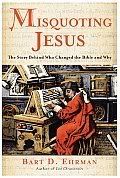
When I first heard about this book I was excited. Finally, a well-researched book on textual criticism written for laymen! Although I was well aware of Ehrman's liberal views, I didn't think this would affect the factual and historical issues related to this subject; and it didn't. Bart Ehrman may very well be one of the foremost authorities on this subject alive today. And I think those who dismiss Ehrman's work without reading it need to give him more credit.
One thing I learned from this book is that liberals CAN do research. I don't care how conservative you are (I am very conservative myself), the historical and factual observations in this work are to be commended. And this brings up a very important point: fundamentalists (in any sense of the word) should not automatically dismiss the work of unbelievers. Too often I encounter those who refuse to buy or even read books like "Misquoting Jesus" simply because they would be "supporting the anti-Christian work of unbelievers." Does Bart Ehrman present conclusions in his books that are simply exaggerated and unreasonable? Yes. Does this mean we should conclude that Bart Ehrman is an apostate who can't do good historical research? No.
The first 5 chapters of this book were excellent. They were based upon true historical research and were almost completely void of Ehrman's presuppositional conclusions that we find in the concluding chapter. I really appreciated the introductory chapter because it allowed the reader to understand exactly where Ehrman was coming from. In no way would the reader be able to start this work and be deceived into thinking that the author was somehow hiding his bias. For example, we read on page 11,
"If one wants to insist that God inspired the very words of scripture, what would be the point if we don't have the very words of scripture...for I came to realize that it would have been no more difficult for God to preserve the words of scripture than it would have been for him to inspire them in the first place. If he wanted his people to have his words, surely he would have given them to them (and possibly even given them the words in a language they could understand, rather than Greek and Hebrew). The fact that we don't have the words surely must show, I reasoned, that he did not preserve them for us. And if he didn't perform that miracle, there seemed to be no reason to think that he performed the earlier miracle of inspiring those words."
I think anyone reading Erhman's words here can see where he is coming from. In essence, he is saying, "unless God transmits the scriptures in a way that is in accordance with my presuppositions, they couldn't possibly have been inspired." Can you imagine the implications of this view? Think about what it would be like if the scriptures were transmitted in the way that Erhman would have preferred;
Take, for example, a monk who is copying the gospel of John. It is about 20 degrees outside and his fire is about to go out. And not only that, but the last meal he ate was about 12 hours ago. His hands are shaking. He is tired. It is late. He knows that if he doesn't get this done tonight...well, it better get finished. Then it happened...he is so exhausted that he accidentally skips a line because it looked so much like the previous one (yes, this happens to all of us...even on computers). And then, "ZZAAPPP!!!!!!" Lightening from the heavens strikes him dead. If this copy of the Gospel of John had been released, then we would have had...yes friends, you guessed correctly, a textual variant!
No matter how easy it would be to dismiss the variant as a simple copyist error, this couldn't happen if Bart Ehrman's view on "inspiration" is true. Do you see the implications of this? God would have to either strike every monk dead who accidentally misspelled a word or copied a line twice, or he would have to temporarily turn them into human dictation machines (now think about THAT!).
Now, I want to be fair to Ehrman. If it weren't for the so-called "theologically motivated alterations" of the texts (such as Luke 5:43-44, according to Ehrman), I don't think that his view on inspiration wouldn't be as radical as they are. But because these changes could have happened (or did happen according to Ehrman), it couldn't be the way God wanted to do it. And it must be emphasized that in the vast majority of cases we know what the original reading was, whether or not the variant was accidental or intentional. So in most of these cases the question is not, "what did the original texts say," but, "was the change accidental or intentional?"
I felt that Ehrman was quite fair in dealing with these variants, but what I don't understand is this; if Bart Erhman believes that it is at least possible to know what the original authors wrote (he claims on p. 210, "A number of scholars...have even given up thinking that it makes sense to talk about the 'original' text. I personally think that opinion may be going too far...so at least it is not "non"-sense to talk about an original text."), why should we conclude that God couldn't have inspired these books? Yes, God used fallible men to copy the scriptures. But isn't it remarkable that in at least 99 percent of the cases (its probably a lot higher, but I'll be generous to the liberals), and out of over 5,000 Greek manuscripts, we know with complete certainty what the original authors wrote down? In addition, those places where it is difficult to determine the original reading, we must keep in mind that we HAVE the original reading; it's in the texts. We just have to choose which text has the original reading.
So the next time someone tells you, "show me the writings of Paul," just pull out a Nestle-Aland 27th edition and a United Bible Society 4th edition Greek New Testament and hand it to him or her. The original writings of Paul are there. We just have to determine what they are (which I must emphasize again; we KNOW what they are AT LEAST 99 percent of the time).
Now, I want to come back to something I mentioned earlier. Many Christians are ignorant, willingly or unintentionally, of these issues. If you see "Misquoting Jesus" as complete trash that shouldn't be read by Christians, then you either a) haven't read the book, or b) are ignorant of textual criticism. Yes, Bart Ehrman's conclusions are far fetched and his presuppositions completely unreasonable. But this makes up a very small percentage of the book. The rest is very excellent, well researched history (and well written, I might add). With this, I want to conclude this review on an encouraging note Christians who are un-informed on this issue.
So let's face it, many of us don't know how we got the Bible. We like to believe that our leather-bonded NIV study Bible magically fell from the heavens into your friendly neighborhood Christian bookstore. We don't like to believe that most Christians in the early church didn't have complete Bibles (considering it was very expensive and often times illegal) and that the copying process was done by hand in a very painstaking way. With this we can somewhat sympathize with Ehrman; if God miraculously inspired the original writings of the texts, why couldn't he have miraculously transmitted them as well (some actually believe that God did this in the King James version of the Bible)? Could Erhman be right? If he is wrong, then why is he wrong?
If you are a Christian, ask yourself, "where did my NIV study Bible come from? Does it matter?" Should you simply trust those who translated your Bible; that they were infallible in choosing which variant readings were the best? How do YOU know that your Bible contains the original readings? For example, how many times have you heard a sermon preached on the woman being caught in adultery (John 8:3-11) with Jesus forgiving her? Bart Ehrman and many other scholars (some even conservative) have concluded that this story wasn't the original reading. Or how about 1 John 5:7, which reads, "For there are three that bear record in heaven, the Father, the Word, and the Holy Ghost: and these three are one." Try to find this verse in your NIV; it's not there. But it's in the KJV. Why? This verse clearly attests to the Trinity. Does it matter if God is three persons that share one being? King James onlyists insist that the King James Bible is God's very words preserved for us in the English language and that all "new" versions, such as the NIV, are corrupt. Are they right? Do you see the implications?
Books like "Misquoting Jesus" are very important and contain information that every Christian needs to be concerned about. So I just want to encourage you, Christian or not, to look into these issues. You don't have to have a Master's degree in Greek exegesis to be informed on these issues. All you need is a desire to study. Don't take my word for it. Don't take Bart Ehrman's word for it. Don't take the KJV translator's word for it. And don't take your pastor's word for it. Study this issue for yourself. The implications and consequences may be eternal.
When I first heard about this book I was excited. Finally, a well-researched book on textual criticism written for laymen! Although I was well aware of Ehrman's liberal views, I didn't think this would affect the factual and historical issues related to this subject; and it didn't. Bart Ehrman may very well be one of the foremost authorities on this subject alive today. And I think those who dismiss Ehrman's work without reading it need to give him more credit.
One thing I learned from this book is that liberals CAN do research. I don't care how conservative you are (I am very conservative myself), the historical and factual observations in this work are to be commended. And this brings up a very important point: fundamentalists (in any sense of the word) should not automatically dismiss the work of unbelievers. Too often I encounter those who refuse to buy or even read books like "Misquoting Jesus" simply because they would be "supporting the anti-Christian work of unbelievers." Does Bart Ehrman present conclusions in his books that are simply exaggerated and unreasonable? Yes. Does this mean we should conclude that Bart Ehrman is an apostate who can't do good historical research? No.
The first 5 chapters of this book were excellent. They were based upon true historical research and were almost completely void of Ehrman's presuppositional conclusions that we find in the concluding chapter. I really appreciated the introductory chapter because it allowed the reader to understand exactly where Ehrman was coming from. In no way would the reader be able to start this work and be deceived into thinking that the author was somehow hiding his bias. For example, we read on page 11,
"If one wants to insist that God inspired the very words of scripture, what would be the point if we don't have the very words of scripture...for I came to realize that it would have been no more difficult for God to preserve the words of scripture than it would have been for him to inspire them in the first place. If he wanted his people to have his words, surely he would have given them to them (and possibly even given them the words in a language they could understand, rather than Greek and Hebrew). The fact that we don't have the words surely must show, I reasoned, that he did not preserve them for us. And if he didn't perform that miracle, there seemed to be no reason to think that he performed the earlier miracle of inspiring those words."
I think anyone reading Erhman's words here can see where he is coming from. In essence, he is saying, "unless God transmits the scriptures in a way that is in accordance with my presuppositions, they couldn't possibly have been inspired." Can you imagine the implications of this view? Think about what it would be like if the scriptures were transmitted in the way that Erhman would have preferred;
Take, for example, a monk who is copying the gospel of John. It is about 20 degrees outside and his fire is about to go out. And not only that, but the last meal he ate was about 12 hours ago. His hands are shaking. He is tired. It is late. He knows that if he doesn't get this done tonight...well, it better get finished. Then it happened...he is so exhausted that he accidentally skips a line because it looked so much like the previous one (yes, this happens to all of us...even on computers). And then, "ZZAAPPP!!!!!!" Lightening from the heavens strikes him dead. If this copy of the Gospel of John had been released, then we would have had...yes friends, you guessed correctly, a textual variant!
No matter how easy it would be to dismiss the variant as a simple copyist error, this couldn't happen if Bart Ehrman's view on "inspiration" is true. Do you see the implications of this? God would have to either strike every monk dead who accidentally misspelled a word or copied a line twice, or he would have to temporarily turn them into human dictation machines (now think about THAT!).
Now, I want to be fair to Ehrman. If it weren't for the so-called "theologically motivated alterations" of the texts (such as Luke 5:43-44, according to Ehrman), I don't think that his view on inspiration wouldn't be as radical as they are. But because these changes could have happened (or did happen according to Ehrman), it couldn't be the way God wanted to do it. And it must be emphasized that in the vast majority of cases we know what the original reading was, whether or not the variant was accidental or intentional. So in most of these cases the question is not, "what did the original texts say," but, "was the change accidental or intentional?"
I felt that Ehrman was quite fair in dealing with these variants, but what I don't understand is this; if Bart Erhman believes that it is at least possible to know what the original authors wrote (he claims on p. 210, "A number of scholars...have even given up thinking that it makes sense to talk about the 'original' text. I personally think that opinion may be going too far...so at least it is not "non"-sense to talk about an original text."), why should we conclude that God couldn't have inspired these books? Yes, God used fallible men to copy the scriptures. But isn't it remarkable that in at least 99 percent of the cases (its probably a lot higher, but I'll be generous to the liberals), and out of over 5,000 Greek manuscripts, we know with complete certainty what the original authors wrote down? In addition, those places where it is difficult to determine the original reading, we must keep in mind that we HAVE the original reading; it's in the texts. We just have to choose which text has the original reading.
So the next time someone tells you, "show me the writings of Paul," just pull out a Nestle-Aland 27th edition and a United Bible Society 4th edition Greek New Testament and hand it to him or her. The original writings of Paul are there. We just have to determine what they are (which I must emphasize again; we KNOW what they are AT LEAST 99 percent of the time).
Now, I want to come back to something I mentioned earlier. Many Christians are ignorant, willingly or unintentionally, of these issues. If you see "Misquoting Jesus" as complete trash that shouldn't be read by Christians, then you either a) haven't read the book, or b) are ignorant of textual criticism. Yes, Bart Ehrman's conclusions are far fetched and his presuppositions completely unreasonable. But this makes up a very small percentage of the book. The rest is very excellent, well researched history (and well written, I might add). With this, I want to conclude this review on an encouraging note Christians who are un-informed on this issue.
So let's face it, many of us don't know how we got the Bible. We like to believe that our leather-bonded NIV study Bible magically fell from the heavens into your friendly neighborhood Christian bookstore. We don't like to believe that most Christians in the early church didn't have complete Bibles (considering it was very expensive and often times illegal) and that the copying process was done by hand in a very painstaking way. With this we can somewhat sympathize with Ehrman; if God miraculously inspired the original writings of the texts, why couldn't he have miraculously transmitted them as well (some actually believe that God did this in the King James version of the Bible)? Could Erhman be right? If he is wrong, then why is he wrong?
If you are a Christian, ask yourself, "where did my NIV study Bible come from? Does it matter?" Should you simply trust those who translated your Bible; that they were infallible in choosing which variant readings were the best? How do YOU know that your Bible contains the original readings? For example, how many times have you heard a sermon preached on the woman being caught in adultery (John 8:3-11) with Jesus forgiving her? Bart Ehrman and many other scholars (some even conservative) have concluded that this story wasn't the original reading. Or how about 1 John 5:7, which reads, "For there are three that bear record in heaven, the Father, the Word, and the Holy Ghost: and these three are one." Try to find this verse in your NIV; it's not there. But it's in the KJV. Why? This verse clearly attests to the Trinity. Does it matter if God is three persons that share one being? King James onlyists insist that the King James Bible is God's very words preserved for us in the English language and that all "new" versions, such as the NIV, are corrupt. Are they right? Do you see the implications?
Books like "Misquoting Jesus" are very important and contain information that every Christian needs to be concerned about. So I just want to encourage you, Christian or not, to look into these issues. You don't have to have a Master's degree in Greek exegesis to be informed on these issues. All you need is a desire to study. Don't take my word for it. Don't take Bart Ehrman's word for it. Don't take the KJV translator's word for it. And don't take your pastor's word for it. Study this issue for yourself. The implications and consequences may be eternal.
Wednesday, January 10, 2007
Does the Bible teach a flat earth?
When you talk to people who are skeptical of the Christian faith and of the Bible, what kind of objections are raised? Do they attack the Bible's historical reliability? Its scientific accuracy? Its inerancy? In my experience, the most common objections have been in the areas of scientific reliability. Some people say that the Bible can't be trusted because "science" has proven that the earth is billions of years old. Others get more specific and ignorantly accuse the Bible as being inaccurate when it speaks of things such as the sun standing still (a.k.a. Joshua's long day) or the "four corners of the earth." And this is because they believe that if Christians are to be consistent, then they need to take the Bible "literally."
So what do you think? Imagine this scenario; what if someone came up to you tomorrow and asked you this question,
skeptic: So, you believe that the Bible is the inerrant word of God, correct?
you: Well, yea.
skeptic: So do you take the Bible literally?
you: of course.
skeptic: Do you believe in a flat earth?
you: lol, are you serious? Of course not.
skeptic: Then what do you do with all the verses that talk about the "four corners of the earth," such as Isaiah 11:12, Revelation 7:1, and 20:8?
So what would you do at this point? If the Bible speaks of the four corners of the earth, and you claim to take the Bible literally, wouldn't that mean that you, too, must believe that the earth is flat? Fortunately, there is an answer to this objection:
skeptic: So, you believe that the Bible is the innerant word of God, correct?
me: yep, sure do.
skeptic: okay, so this must mean that you take the Bible literally, do you not?
me: well, it depends on what you mean by that. I prefer to make the claim that I read the Bible plainly. Or in other words, I read the Bible as the original authors would have intended it. You see, the Bible is a work of literature, and an ancient work at that. So we must take into consideration that the authors would have written in various genres, such as poetry, historical narrative, allegory, etc. This means that some passages might speak in purely historical terms, such as "Then Samuel died; and all Israel gathered together and mourned for him, and buried him at his house in Ramah." (1 Samuel 25:1). But other times, passages will use a more metaphorical approach in order to get a point across, such as, "I am the vine, you are the branches," in John 15:5. Obviously, the author isn't trying to tell us that Jesus has limbs with leaves growing out of them. So how do we know when the Bible is speaking metaphorically or literally? Context, context, context. Just as in other works of literature, the author will often indicate whether or not he is writing poetry, allegory, or history. We have to pay attention to the context.
skeptic: alright, I can see how that approach might be legitimate. So let me ask you another question. Do you believe in a flat earth?
me: of course not.
skeptic: then what do you do with all the Bible verses that speak of the four corners of the earth?
me: I interpret those passages in light of their context. The word translated "corners," is the Hebrew word, Kanaph. Kanaph is translated in a variety of ways. However, it generally means "extremity." It is translated "borders" in Numbers 15:38. In Ezekiel 7:2 it is translated "four corners" and again in Isaiah 11:12 as "four corners." It is translated in Job 37:3 and 38:13 as "ends." Regardless of the various ways kanaph is translated, it makes reference to EXTREMITIES. The Greek equivalent in Revelation 7:1 is gonia. Gonia literally means "angles, or divisions," just like how we divide a map into quadrants as shown by the four directions. But lets say that God intended the language to mean a literal corner or end, rather than an extreme. If He had, any of the following Hebrew words could have been used:
1. Pinoh is used in reference to the cornerstone.
2. Paioh means "a geometric corner"
3. Ziovyoh means "right angle" or "corner"
4. Krnouth refers to a projecting corner.
5. Paamouth means "square."
If God wanted to convey the idea of a square, four-cornered earth, the Hebrew word paamouth should have been used. Instead, the Holy Spirit selected the word kanaph, conveying the idea of an extremity. It is doubtful that any religious Jew would ever misunderstand the true meaning of kanaph. The Book of Isaiah describes how the Messiah, the Root of Jesse, shall re-gather his people from the four corners of the earth. They shall come from every "extremity" to be gathered into Israel.
"And in that day there shall be a Root of Jesse,
Who shall stand as a banner to the people;
For the Gentiles shall seek Him,
And His resting place shall be glorious."
It shall come to pass in that day
That the LORD shall set His hand again the second time
To recover the remnant of His people who are left,
From Assyria and Egypt,
From Pathros and Cush,
From Elam and Shinar,
From Hamath and the islands of the sea.
He will set up a banner for the nations,
And will assemble the outcasts of Israel,
And gather together the dispersed of Judah
From THE FOUR CORNERS OF THE EARTH”
Skeptic: okay okay, I see where you are going. But you can't get away from the fact that the word "corner" is used in the English translations. Why would the translators do this if it didn't refer to a literal corner?
me: Its the same reason modern astronomers will speak of the sun's "rising and setting." You wouldn't accuse them of scientific inaccuracy now would you? Obviously not, because they are merely using the earth as a reference point and describing the sun in language of appearance. In other words, when the Biblical authors used the word "corners," they were trying to get a point across, much like someone today would say, "During WWII, men from the ends of the earth came to fight the battle." Hopefully no one would accuse this person of believing in a flat earth would they? Certainly not, because they are merely using "ends" to indicate far distances.
skeptic: well, I see how this might not have been a reasonable objection after all. But i have another question concerning dinosaurs. Now honestly, do you really believe...
So what do you think? Imagine this scenario; what if someone came up to you tomorrow and asked you this question,
skeptic: So, you believe that the Bible is the inerrant word of God, correct?
you: Well, yea.
skeptic: So do you take the Bible literally?
you: of course.
skeptic: Do you believe in a flat earth?
you: lol, are you serious? Of course not.
skeptic: Then what do you do with all the verses that talk about the "four corners of the earth," such as Isaiah 11:12, Revelation 7:1, and 20:8?
So what would you do at this point? If the Bible speaks of the four corners of the earth, and you claim to take the Bible literally, wouldn't that mean that you, too, must believe that the earth is flat? Fortunately, there is an answer to this objection:
skeptic: So, you believe that the Bible is the innerant word of God, correct?
me: yep, sure do.
skeptic: okay, so this must mean that you take the Bible literally, do you not?
me: well, it depends on what you mean by that. I prefer to make the claim that I read the Bible plainly. Or in other words, I read the Bible as the original authors would have intended it. You see, the Bible is a work of literature, and an ancient work at that. So we must take into consideration that the authors would have written in various genres, such as poetry, historical narrative, allegory, etc. This means that some passages might speak in purely historical terms, such as "Then Samuel died; and all Israel gathered together and mourned for him, and buried him at his house in Ramah." (1 Samuel 25:1). But other times, passages will use a more metaphorical approach in order to get a point across, such as, "I am the vine, you are the branches," in John 15:5. Obviously, the author isn't trying to tell us that Jesus has limbs with leaves growing out of them. So how do we know when the Bible is speaking metaphorically or literally? Context, context, context. Just as in other works of literature, the author will often indicate whether or not he is writing poetry, allegory, or history. We have to pay attention to the context.
skeptic: alright, I can see how that approach might be legitimate. So let me ask you another question. Do you believe in a flat earth?
me: of course not.
skeptic: then what do you do with all the Bible verses that speak of the four corners of the earth?
me: I interpret those passages in light of their context. The word translated "corners," is the Hebrew word, Kanaph. Kanaph is translated in a variety of ways. However, it generally means "extremity." It is translated "borders" in Numbers 15:38. In Ezekiel 7:2 it is translated "four corners" and again in Isaiah 11:12 as "four corners." It is translated in Job 37:3 and 38:13 as "ends." Regardless of the various ways kanaph is translated, it makes reference to EXTREMITIES. The Greek equivalent in Revelation 7:1 is gonia. Gonia literally means "angles, or divisions," just like how we divide a map into quadrants as shown by the four directions. But lets say that God intended the language to mean a literal corner or end, rather than an extreme. If He had, any of the following Hebrew words could have been used:
1. Pinoh is used in reference to the cornerstone.
2. Paioh means "a geometric corner"
3. Ziovyoh means "right angle" or "corner"
4. Krnouth refers to a projecting corner.
5. Paamouth means "square."
If God wanted to convey the idea of a square, four-cornered earth, the Hebrew word paamouth should have been used. Instead, the Holy Spirit selected the word kanaph, conveying the idea of an extremity. It is doubtful that any religious Jew would ever misunderstand the true meaning of kanaph. The Book of Isaiah describes how the Messiah, the Root of Jesse, shall re-gather his people from the four corners of the earth. They shall come from every "extremity" to be gathered into Israel.
"And in that day there shall be a Root of Jesse,
Who shall stand as a banner to the people;
For the Gentiles shall seek Him,
And His resting place shall be glorious."
It shall come to pass in that day
That the LORD shall set His hand again the second time
To recover the remnant of His people who are left,
From Assyria and Egypt,
From Pathros and Cush,
From Elam and Shinar,
From Hamath and the islands of the sea.
He will set up a banner for the nations,
And will assemble the outcasts of Israel,
And gather together the dispersed of Judah
From THE FOUR CORNERS OF THE EARTH”
Skeptic: okay okay, I see where you are going. But you can't get away from the fact that the word "corner" is used in the English translations. Why would the translators do this if it didn't refer to a literal corner?
me: Its the same reason modern astronomers will speak of the sun's "rising and setting." You wouldn't accuse them of scientific inaccuracy now would you? Obviously not, because they are merely using the earth as a reference point and describing the sun in language of appearance. In other words, when the Biblical authors used the word "corners," they were trying to get a point across, much like someone today would say, "During WWII, men from the ends of the earth came to fight the battle." Hopefully no one would accuse this person of believing in a flat earth would they? Certainly not, because they are merely using "ends" to indicate far distances.
skeptic: well, I see how this might not have been a reasonable objection after all. But i have another question concerning dinosaurs. Now honestly, do you really believe...
Subscribe to:
Posts (Atom)

 Posts
Posts


